Marxist
Education Portal

Education Portal
The previous lesson outlined how, as part of the vital preparation for the October revolution, a battle had to be waged within the Bolshevik leadership itself, against those like Zinoviev and Kamenev who were arguing that mounting an insurrection would end in defeat. This lesson continues the account of that internal party struggle, summarised from Chapters 4 & 5 of Volume 3 of Trotsky’s ‘History’, as well as from the first of the accompanying appendices that Trotsky added to that final volume as well.
Lenin mounts his campaign
Trotsky describes how, from his enforced isolation, Lenin carefully studied the changing tempo of events, analysing election figures and reports of the peasant struggles. His conclusions were expressed in his letters to the Bolshevik Central Committee (C.C.). In them, Lenin proposed with increasing urgency the need to organise the insurrection.
“Lenin had said more than once that the masses are to the left of the party. He knew that the party was to the left of its own upper layer of ‘old Bolsheviks.’ He was too well acquainted with the inner groupings and moods in the Central Committee to expect from it any hazardous steps whatever. On the other hand he greatly feared excessive caution … a letting slip of one of those historic situations which are decades in preparation. Lenin did not trust the Central Committee – without Lenin. In that lies the key to his letters from underground. And Lenin was not so wrong in his mistrust” [Volume Three, Chapter Five 19].
In mid-September, on hearing that a majority of peasant delegates at the Democratic Conference had voted against a coalition with the Kadets, Lenin drew the conclusion that the peasantry had only one alternative left to them – to support the Bolsheviks.
Trotsky records how Lenin wrote to the C.C.: “ ‘Having got a majority in the soviets of both capitals ... the Bolsheviks can and should seize the state power in their hands. The people are tired of the wavering of the Mensheviks and Social Revolutionaries. Only our victory in the capitals will bring the peasants over to us.’ The task of the party is: ‘To place upon the order of the day armed insurrection in Petersburg and Moscow, conquest of power, overthrow of the government ...’ Up to that time nobody had so imperiously and nakedly set the task of insurrection” [Volume Three, Chapter Five 19].
Lenin went as far as proposing that the Bolsheviks deploy troops to surround the theatre where the Democratic Conference was sitting and take over Petrograd. This was a bewildering acceleration of tempo for a Party where a majority of its delegates to the Conference were still, at this stage, opposed to even boycotting this ‘Pre-Parliament’.
Certainly, not a single member of the Bolshevik C.C. was prepared to support Lenin’s plan. Some even wanted all copies of Lenin’s letter burnt! But the C.C. members’ reasons for rejecting the proposal were far from identical. Some of the right-wing were totally opposed to insurrection, others on the left simply felt that this particular plan was ill-judged, others again were simply vacillating and waiting on events.
Unable to persuade the C.C., Lenin sought out, and found, a point of support in Smilga, the young President of the Regional Committee of the Soviets in Finland. Lenin’s new plan for insurrection involved gathering the most reliable forces stationed in Finland and the Baltic fleet to move on Petrograd.
As Trotsky points out: “This new draft of a plan, like the preceding one, was not realised. But it did not go by without effect. With his extremely sharp posing of the question Lenin permitted nobody to evade or manoeuvre. What seemed untimely as a direct tactical proposal became expedient as a test of attitudes in the Central Committee, a support to the resolute against the wavering …” [Volume Three, Chapter Five 19].
Lenin was taking every opportunity available to him from his isolated position to impress on the party cadres the acuteness of the situation. As his September 29th letter ‘The Crisis is Ripe’ explained, his assessment was that the agrarian movement had reached fever-pitch and that to allow Kerensky to defeat the peasant revolt would ruin the revolution. An urgent insurrection had become a necessity and to delay until the Congress of Soviets, as he judged the party leadership were intending to do, would be ‘utter idiocy’.
To show how serious he was in his criticism, Lenin tendered his resignation from the C.C. “He gives his reasons: the Central Committee has made no response … to his insistence in regard to the seizure of power; the editorial board of the party organ (Stalin) is printing his articles with intentional delays, omitting from them his indication of such ‘flagrant mistakes of the Bolsheviks as their shameful decision to participate in the Pre-Parliament. I am compelled to request permission to withdraw from the C.C. … and leave myself freedom of agitation in the lower ranks of the party and at the party congress’ ” [Volume Three, Chapter Five 19].
Lenin never did formally withdraw from the C.C., but exceptionally went beyond its norms of collective responsibility to widen his internal campaign within the Party. He copied the letter he had written to the C.C. to both the Petrograd and Moscow committees as well as making sure that it, and others following, circulated more widely amongst the key district committees. For example, Krupskaya, Lenin’s wife, read the letters to the Vyborg district committee, carefully checking the originals against copies being typed in the local party office for further circulation.
As the ranks began to realise that Lenin had been campaigning for some time for the C.C. to proceed to an insurrection, they added their own pressure on the leadership to support Lenin’s proposal. In early October, a Petrograd party conference agreed to ‘insistently request’ the C.C. prepare for the ‘inevitable insurrection’. On the 8th, Lenin wrote to the Bolshevik delegates to the forthcoming Northern Regional Congress of Soviets proposing a reworked plan – that the Congress itself takes the initiative and assembles the forces it represented – including those of Finland, Reval and the Baltic fleet – to move on Petrograd.
The Congress delegates did not support Lenin’s specific proposal, judging it to be tactically incorrect. “Lenin’s isolation did not prevent him from defining with incomparable penetration the fundamental stages and turns of the movement, but it deprived him of the possibility of making timely estimates of episodic factors and temporary changes” [Appendix One to Volume Three 26].
Of course, Lenin himself was acutely aware of such difficulties, saying in one of his letters: “A publicist set somewhat aside by the will of destiny from the main line of history constantly incurs the risk of coming in late or being uninformed” [Appendix One to Volume Three 26].
Nevertheless, despite these inevitable tactical misjudgements, Lenin’s general campaign in favour of insurrection helped put the Bolsheviks on the right road. Trotsky writes that: “It required a mighty confidence in the proletariat, in the party, but also a very serious mistrust of the Central Committee, in order over its head, upon his own personal responsibility, from underground, and by means of a few small sheets of notepaper minutely inscribed, to raise an agitation for an armed revolution. How could it happen that Lenin [found himself again] … isolated among the leaders of his own party? This cannot be understood if you believe the unintelligent legend which portrays the history of Bolshevism as an emanation of the pure revolutionary idea. In reality Bolshevism developed in a definite social milieu … among them the influence of a petty bourgeois environment and of cultural backwardness. To each new situation the party adapted itself only by way of an inner crisis” [Volume Three, Chapter Five 19].
The C.C. of October 10th
At Lenin’s insistence, an emergency session of the Bolshevik Central Committee was convened on October 10th, to reach a decision on the question of insurrection. It was held, without his knowledge, in the security of the Menshevik Sukhanov’s apartment, thanks to arrangements made by his Bolshevik wife. Twelve of the twenty-one C.C. members attended, including Lenin himself who arrived clean-shaven and wearing a wig and spectacles as a disguise. The meeting went on for ten hours, lasting deep into the night.
Sverdlov opened with an organisational report which, by previous arrangement with Lenin, emphasised reports that military headquarters were preparing to march counter-revolutionary troops from the western front to Petrograd. Sverdlov added, encouragingly, that the revolutionary garrison in Minsk was ready to disarm Kerensky’s men and march to the capital themselves.
Lenin then set out his case, passionately warning that, if they waited any longer, the Bolsheviks could lose the vital moment to seize power, that the peasant uprising created a favourable political situation, and that the technical detail of the insurrection must now be agreed on. He proposed using the support offered by the Minsk soldiers and repeated his plan of using the northern congress to initiate ‘decisive action’. Certainly, Lenin argued, the party must not wait for the Congress of Soviets whose assembly might, in any case, be forcibly prevented by government troops.
Lenin presented a quickly pencil-written resolution setting out the international situation, the peasant uprising and growth in support for the Bolsheviks, the government’s policy to surrender Petrograd to the Germans and military headquarters’ preparations for a new Kornilov attack. From this background flowed the need to decide on the ‘coming-out’ of Moscow and Minsk, plans to initiate action from the Northern Congress and, added at Trotsky’s suggestion, also to resist the ‘withdrawal of troops’ from Petrograd.
It was this last point that would indeed be developed to construct the actual insurrection in the capital, rather than Lenin’s scheme. However, for reasons of security, no practical details were included in Lenin’s written resolution in any case. However, in discussion, it was concluded that it should take place no later than October 15th when the Northern Region Congress was due to close. Trotsky knew this was a tight timescale but did not want to call for any delay which could bolster the right-wing. In any event, it was certainly understood that the insurrection would have to take place before the Congress of Soviets, still being called at this stage for October 20th.
Lenin had expected to encounter strong opposition. As well as harbouring doubts about some of his ‘old Bolshevik’ comrades, he had little knowledge of the views of Joffé and Uritzky, who had been former Mezhrayontsi with Trotsky. But he was soon reassured that the new Central Committee members were solidly in support of insurrection. Trotsky writes that: “the unanimity with which the Central Committee had rejected the proposal of immediate insurrection in September had been episodic. During the three weeks following there had been a considerable shift to the left in the Central Committee. Ten against two voted for the insurrection. That was a big victory!” [Volume Three, Chapter Five 19].
Although only Zinoviev and Kamenev voted against the resolution at the C.C. meeting, they were not the only party leaders still opposed to insurrection. Even some of those voting in favour still saw insurrection as a more distant goal. Other C.C. members like Rykov and Nogin, absent from the meeting on the 10th, sided with Zinoviev and Kamenev. Some of the leaders of the Bolsheviks’ Military Organisation were particularly strongly opposed to Lenin’s plan, exaggerating the logistical difficulties, rather than taking into account the favourable political situation.
But there were Bolshevik members with doubts throughout the Party. Trotsky quotes from an old worker-Bolshevik in the solidly working-class city of Ivanovo-Voznesensk, where those opposed to the C.C.’s proposal, mainly the intellectuals, would privately go as far as to say that “Lenin is a crazy man; he is pushing the working-class to certain ruin. From this armed insurrection we will get nothing; they will shatter us, exterminate the party and the working-class, and that will postpone the revolution for years and years ...” [Volume Three, Chapter Five 19].
While there was still inertia amongst the Petrograd leadership, the hesitations of the Moscow leaders were even greater. When it came to the eventual insurrection - to be analysed in later lessons - these hesitations almost led to the defeat of the insurrection in Moscow, which, unlike Petrograd, in the end took eight days to conclude and cost many victims. The Kyiv leaders were even less prepared and helped the bourgeoisie to keep hold of power through the Rada.
Trotsky notes tellingly that: “in a whole series of provincial cities the Bolsheviks formed in October a bloc with the Compromisers ‘against the counter-revolution.’ As though the Compromisers were not at that moment one of its chief supports! Almost everywhere a push was required both from above and below to shatter the last indecisiveness of the local committee, compel it to break with the Compromisers and lead the movement. On the eve of the overturn the official machine even of this most revolutionary party put up a big resistance. Conservatism inevitably finds its seat in a bureaucracy. The machine can fulfil a revolutionary function only so long as it remains an instrument in the service of the party, so long as it remains subordinate to an idea and is controlled by the mass” [Volume Three, Chapter Five 19]
Nevertheless, the vital vote at the October 10th Central Committee meeting gave the supporters of insurrection the confidence of knowing that they were arguing for the official position of the party. The most resolute cadres now came to the fore and took on the task of stepping up the party’s campaign, and preparing its forces, for an overturn.
Zinoviev and Kamenev attack
The shift to the left in the Bolshevik Party only deepened Zinoviev’s and Kamenev’s concerns. They chose to distribute a lengthy statement to party members opposing insurrection. Their alternative policy was for the Bolsheviks to form a strong opposition, perhaps managing to win a third of the seats, in the Constituent Assembly. Completely forgetting the Marxist theory of the state, they believed that, at one and the same time, the Bolsheviks could continue to conduct ‘revolutionary work’ through its majority in the soviets.
Somehow, Zinoviev and Kamenev imagined that a dual power between the proletariat’s soviets and the bourgeoisie’s Constituent Assembly could be peacefully maintained, allowing the Bolsheviks to gradually extend their support yet further.
But, as Trotsky explains: “a revolutionary situation cannot be preserved at will. If the Bolsheviks had not seized the power in October and November, in all probability they would not have seized it at all. Instead of firm leadership the masses would have found among the Bolsheviks that same disparity between word and deed which they were already sick of, and they would have ebbed away in the course of two or three months from this party which had deceived their hopes, just as they had recently ebbed away from the Social Revolutionaries and Mensheviks. A part of the workers would have fallen into indifferentism, another part would have burned up their force … in anarchistic flare-ups … dictated by revenge and despair. The breathing-spell thus offered would have been used by the bourgeoisie to conclude a separate peace [with Germany], and stamp out the revolutionary organisations. Russia would again have been included in the circle of capitalist states as a semi-imperialist, semi-colonial country. The proletarian revolution would have been deferred to an indefinite future” [Volume Three, Chapter Five 19].
But it was now Zinoviev and Kamenev who were in breach of party discipline, isolated within the C.C., not Lenin. A new meeting of the Central Committee, together with representatives from other key party organisations, was called, again at Lenin’s insistence. It was held in the suburb of Lesny on October 16th. Trotsky himself was absent, as he was busy guiding the resolution on the MRC through the Soviet which was meeting at the same time.
By now, the original deadline posed for the insurrection at the previous C.C. of the 15th had passed. As Joffé pointed out, this had proved to be too tight a deadline in practice, not just for organisational reasons but also to allow sufficient time to politically prepare support amongst the masses. It was perhaps just as well that, on the 17th, the Compromisers announced that the opening of the Congress of Soviets was being put back by a few days, to the 25th.
But Kamenev used the failure to meet the deadline as an argument to show that an insurrection at any time was pure adventurism. Others, like Miliutin, added their view that the party should be ready for defensive action should the government attack, but should not take the initiative themselves.
Lenin attacked their pessimistic appraisal and was supported by Krylenko who had just returned from the Northern Regional Congress. However, Krylenko argued against setting a precise date for insurrection, taking up the approach being pursued through the MRC which Trotsky was outlining at the Soviet. This made the conflict between the garrison and its command the basis of the plan of insurrection: “The question of the removal of the troops is just that fighting issue upon which the struggle is taking place. The attack upon us is thus already a fact, and this we can make use of. It is not necessary to worry about who shall begin, for the thing is already begun” [Volume Three, Chapter Five 19].
Lenin, whose underground existence had left him unable to participate in the actual debate taking place amongst the workers and soldiers, still feared any delays which might be interpreted as support for Zinoviev and Kamenev’s outright opposition. However, this was now the real principled debate within the party – how to find the best route to the insurrection, both technically and politically.
In practice, the insurrection continued to mature along the lines set out at the Military Revolutionary Committee with the support of the Soviet and the Garrison Conference. Trotsky points out that, with the political reliability of some elements in doubt, and with its members scattered from Moscow to Finland, the Bolshevik C.C. actually only played a secondary role at this stage. “The minutes show that the most important questions – that about the Congress of Soviets, the garrison, the Military Revolutionary Committee – were not discussed in advance in the Central Committee and did not issue from its initiative, but arose in Smolny out of the practical activity of the Soviet, and were worked over in the circle of soviet leaders – oftenest with the participation of Sverdlov” [Appendix One to Volume Three 26].
Nevertheless, the victory by twenty votes to two (Zinoviev and Kamenev), with three abstentions, for Lenin’s resolution calling for ‘an all-sided and most vigorous preparation of armed insurrection’ at the October 16th C.C. meeting was another important confirmation of Party policy.
But Zinoviev and Kamenev, rather than accepting the vote, issued a declaration the following day attacking the C.C.’s decision. Shamefully, they chose not to print their opposition on this sensitive internal matter in the Bolshevik press, but in the paper published by the Menshevik, Gorky.
Trotsky answers the rumours
The debates in the party and soviets, factories and barracks, inevitably created rumours that the insurrection was at hand. Newspaper editorials were now devoted to the issue, with Gorky demanding the Bolsheviks refute the suggestion that they were planning a seizure of power. But the uncertainty was disconcerting the workers and soldiers, as well as the enemies of the revolution. Some began to ask whether an insurrection was perhaps being prepared behind their backs. The Bolsheviks needed to clarify the situation.
On the evening of October 18th, after the Garrison Conference, Trotsky made a declaration to the Petrograd Soviet: “ ‘During the last days … the press has been full of … rumours. The Soviet is an elective institution, and cannot have a decision which would not be known to the workers and soldiers. I declare in the name of the Soviet that no armed actions have been settled upon by us, but if the Soviet in the course of events should be obliged to set the date for a coming-out, the workers and soldiers would come out to the last man at its summons’. The delegates understood: the battle was near, but without them and over their heads the signal would not be given” [Volume Three, Chapter Four 18].
“However, besides a reassuring explanation, the masses had to have a clear revolutionary prospective. For this purpose the speaker united the two questions – removal of the garrison and coming Congress of Soviets. ‘We will not permit them ... to strip Petrograd of its revolutionary garrison. It is known to the bourgeoisie that the Petrograd Soviet is going to propose to the Congress of Soviets that they seize the power. And foreseeing an inevitable battle, the bourgeois classes are trying to disarm Petrograd. At the first attempt of the counter-revolution to break up the Congress, we will answer with a counter-attack which will be ruthless, and which we will carry through to the end.’ Here, too, the announcement of a decisive political offensive was made under the formula of military defence” [Volume Three, Chapter Four 18].
As Sukhanov, a Menshevik intellectual opposed to insurrection, later aptly put it: “For Smolny … the question of the garrison is a question of insurrection; for the soldiers it is a question of their own fate. ‘It would be difficult to imagine a more fortunate starting point for the policy of those days.’ ” [Volume Three, Chapter Four 18].
The C.C. divisions widen
While the MRC was extending its influence over the capital, the dispute within the Bolshevik leadership was growing more acute.
Straight after Trotsky had spoken to the Petrograd Soviet on the 18th, Kamenev had deceitfully stepped in to announce that he supported everything that the MRC President had said. Of course, for tactical reasons, Trotsky had avoided directly admitting that the Bolsheviks were preparing for insurrection.
“Whereas Trotsky was juridically screening a policy of attack with a speciously defensive formula, Kamenev tried to make use of Trotsky’s formula – with which he was in radical disagreement – in order to screen a directly opposite policy” [Volume Three, Chapter Five 19].
Kamenev’s action had been intolerable. Trotsky decided to refer the matter to the next meeting of the Bolshevik C.C. on October 20th. In the meantime, Kamenev had resigned from the Central Committee in order to himself be able to agitate against insurrection.
Sverdlov supported Trotsky’s motion accepting Kamenev’s resignation and read out a letter from Lenin attacking Kamenev for his trickery and demanding both his and Zinoviev’s expulsion from the party for making their declaration in Gorky’s paper. Meanwhile Zinoviev, along with Lunacharsky, had separately written to the party press, also dishonestly saying that they ‘agreed’ with Trotsky as if to claim that he sided with them in opposing insurrection.
Trotsky explains that “it is easier to theorise about a revolution afterward than absorb it into your flesh and blood before it takes place. The approach of an insurrection has inevitably produced, and always will produce, crisis in the insurrectionary parties. Just as Lenin more fully and resolutely than others expressed in the autumn months of 1917 the objective necessity of an insurrection, and the will of the masses of revolution, so Zinoviev and Kamenev more frankly than others incarnated the blocking tendencies of the party … the influence of petty bourgeois connections, and the pressure of the ruling classes” [Volume Three, Chapter Five 19].
He adds: “between the saints as the church paints them and the devils as the candidates for sainthood portray them, there are to be found living people. And it is they who make history. The high temper of the Bolshevik party expressed itself not in an absence of disagreements … but in the fact that in the most difficult circumstances it gathered itself in good season by means of inner crises, and made good its opportunity to interfere decisively in the course of events. Lenin taught the party to create its own social opinion, resting upon the thoughts and feelings of the rising class. Thus by a process of selection and education, and in continual struggle, the Bolshevik party created not only a political but a moral medium of its own, independent of bourgeois social opinion and implacably opposed to it. Only this permitted the Bolsheviks to overcome the waverings in their own ranks and reveal in action that courageous determination without which the October victory would have been impossible” [Volume Three, Chapter Five 19].
The role of Stalin
Shamefully Stalin, in his role as one of the editors of the party paper, had published Zinoviev’s dishonest letter with an accompanying note declaring sympathetically that, after all, the whole party was fundamentally ‘in agreement’ and criticising Lenin for being too sharp. But, as Trotsky puts it: “as though at that moment there could be a more fundamental question than the question of insurrection!” [Volume Three, Chapter Five 19].
Stalin was in the minority voting to refuse Kamenev’s resignation and also argued, unsuccessfully, that Kamenev and Zinoviev should be allowed to continue their struggle against the C.C. decision, just when all energies needed to be directed towards the impending insurrection!
Trotsky observes that “this conduct on the part of Stalin might seem inexplicable in the light of the legend which has been created around him. In reality it fully corresponds to his spiritual mould and his political methods. His suspicious caution almost organically compels him at moments of great decision and deep difference of opinion to retire into the shadow, to wait, and if possible to insure himself against both outcomes. Stalin made [his] editorial comment by no means through light-mindedness … he did not think it advisable to burn irrevocably his bridge to the camp of the enemies of the uprising” [Volume Three, Chapter Five 19].
“Stalin took no part at all in the work of the Military Revolutionary Committee and never appeared at its meetings … He was always a ‘centrist’ in Bolshevism. That is, he tended organically to occupy an intermediate position between Marxism and opportunism. The self-contradictory character of centrism made it impossible for Stalin to occupy any independent position in the revolution. On the other hand, those traits which paralysed him at the great turning point of history - watchful waiting and empirical manoeuvring - must necessarily assure him a genuine ascendancy when the mass movement begins to ebb and the functionary comes to the front with his zeal to consolidate what has been attained - that is, primarily to insure his own position against new disturbances. The functionary, ruling in the name of a revolution, has need of revolutionary prestige. In his capacity as an ‘old Bolshevik’, Stalin proved the most suitable incarnation of this prestige imaginable” [Appendix One to Volume Three 26].
18. Leon Trotsky (1930) The History of the Russian Revolution: Volume Three, Chapter Four, is available at: https://www.marxists.org/archive/trotsky/1930/hrr/ch41.htm (Accessed 17 June 2026)
19. Leon Trotsky (1930) The History of the Russian Revolution: Volume Three, Chapter Five, is available at: https://www.marxists.org/archive/trotsky/1930/hrr/ch42.htm (Accessed 17 June 2026)
26. Leon Trotsky (1930) The History of the Russian Revolution: Appendix One to Volume Three, is available at: https://www.marxists.org/archive/trotsky/1930/hrr/apdx-b1.htm (Accessed 17 June 2026)
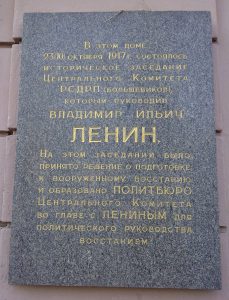
A plaque recording the CC meeting at Sukhanov’s apartment