Marxist
Education Portal

Education Portal
This lesson explains how, despite arrests, destruction of their hard-won printing equipment, and all of the other setbacks that followed the ‘July Days’, the Bolsheviks managed to weather the storm and recover temporarily lost ground. What’s more, it shows how, in Moscow and other cities, the Bolsheviks were also now gaining new ground, as workers outside Petrograd began to catch up with those in the capital. But it also draws out important points made by Trotsky about how a revolution develops, not in a straight line but through a series of ebbs and flows.
As the references show, the lesson is based on a range of different chapters from ‘Volume Two’ of Trotsky’s ‘History’.
The State Conference is called
At the end of July, the government announced that it was calling a state conference in Moscow on August 13th. The Compromisers desperately hoped they could use it to appeal to the bourgeoisie to reach an agreed compromise. Kerensky hoped the event would allow him to display his qualities as saviour of the nation! But the bourgeoisie – and the Bolsheviks – knew that the real struggle was for power – of either the bosses or workers.
The representatives were to come from all classes and organisations but “the government took care to make sure in advance that the conference should contain an equal number of representatives from the possessing classes and the people. Only by means of this artificial equilibrium could the government of the salvation of the revolution still hope to save itself” [Volume Two, Chapter Five 5].
When the Conference assembled, it became clear that, in fact, the ‘balance’ had been set decisively in favour of the right-wing. For every peasant deputy, there were equal numbers of landlords. For each Soviet representative, there were three times as many delegates from the state Duma!
The Compromisers knew they couldn’t afford to allow any Bolshevik speakers to sabotage their plans. The E.C. ruled that party factions could only speak if allowed by the conference praesidium. To their shock, the Bolsheviks replied by announcing that they would not take their seats. Instead, they were going out into the city to speak to the workers of Moscow.
In expectation of a more welcoming environment than Petrograd, the reaction had chosen Moscow as the venue for a number of counter-revolutionary conferences in August. But they were about to find out that the mood of the city’s workers was rapidly catching up with those of their brothers and sisters in the capital.
The combined effect of the provocative speeches being made by the reaction in their own city, together with Bolshevik agitation, had stung the workers and soldiers of Moscow into action. Now the demand came from the shop floor of the Moscow factories to call a general strike in opposition to the state conference.
The Moscow Soviet, with Compromisers, elected some time beforehand, at its head, voted to oppose the strike. But it was now far out of step with the real mood of the workers. The trade unions called the action in any case. Most of the district soviets voted in support. One even voted by 175 to 4 to demand the recall of the delegates to the Moscow Soviet that had voted against it!
Despite this, the night before the strike was a nervous one for the Bolsheviks. They remembered only too well how, just a few weeks earlier, the July demonstrations had been so poorly supported in Moscow. Just as then, the Compromisers in the Moscow Soviet were doing everything they could to dissuade the workers from taking action.
The Bolsheviks had no need to worry. The August 12th strike was solid. 400,000 workers took part in Moscow and its suburbs. Its effects made sure that every conference delegate was made personally aware of the Moscow workers’ hostility to the government. There were no lights, no trams running. Even the waiters had gone on strike!
Similar action, general or partial, had taken place in Kyiv and other cities too. This one-day action fitted the needs of the moment perfectly. It avoided an armed clash that would only have played into the hands of the reaction. Above all, it demonstrated with absolute clarity that the Petrograd workers no longer needed to fear isolation from those of Moscow and the other main cities.
“The new Petrograd organ of the party, ‘The Proletarian’, managed - before it was shut down - to put a question to the Compromisers: ‘From Petrograd you went to Moscow – where will you go from there?’ Even the masters of the situation must have put this question to themselves” [Volume Two, Chapter Six 6].
The Bolsheviks had used the events to hammer home their message that the State Conference was really being called to prepare a conspiracy against the revolution. This was no exaggeration. In the days before the Conference, Kornilov had ordered four cavalry divisions to get ready to move on Petrograd. A Cossack regiment sent to Moscow ‘to preserve order’ had only been held up by Kerensky’s command. Rumours of an impending insurrection spread.
Later testimony suggests that the Conference wasn’t planned as a date for the actual overthrow. Kornilov had apparently chosen August 27th as the date for his action. He hoped Riga would by then have fallen to the Germans, so he could use this defeat as a pretext for his coup. He certainly did little to defend Riga even though it was strategically critical for the defence of Petrograd.
But even the Compromisers could take no chances. The Moscow Soviet elected its own secret defence committee of six people – including two Bolsheviks. “The Bolsheviks, who had been forbidden entry into the barracks since the July Days, were now freely admitted: without them it was impossible to win over the soldiers. While in the open arena the Mensheviks and Social Revolutionaries were negotiating with the bourgeoisie for the creation of a strong power against the masses led by the Bolsheviks, behind the scenes these same Mensheviks and Social Revolutionaries in co-operation with the Bolsheviks … were preparing the masses for a struggle against the conspiracy of the bourgeoisie” [Volume Two, Chapter Six 6].
The Moscow State Conference
To an independent observer, the State Conference debates would have had an air of unreality about them. Both the bourgeoisie and the Compromisers sought to pretend that the reality of the gathering storm of the revolutionary masses was just an unwelcome illusion. In this fantasy world, the exhausted Coalition was spoken of as a means to future salvation, the weak-willed Kerensky as a forceful statesman, the hated Kornilov as a beloved leader of the people.
The speeches from the two aspiring rulers, Kornilov and Kerensky, brought very different reactions from the divided delegates. Kerensky spoke on the 12th to applause – but mainly from the ‘left’ half of the hall.“‘Many provincials,’ writes Miliukov, ‘saw Kerensky in this hall for the first time, and they went out half disappointed and half indignant. Before them stood a young man with a tortured pale face, and a pose like an actor speaking his lines. This man seemed to be trying to frighten somebody and create upon all an impression of power and force of will. In reality he evoked only a feeling of pity’ ” [Volume Two, Chapter Seven 7].
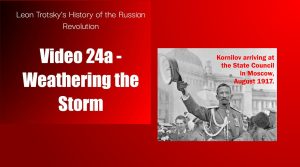
The next day, Kornilov had arranged for himself a grand entry into Moscow for the Conference. A crowd of delegates, officers, and other wealthy supporters greeted his train at the station. Kornilov’s biography and portrait were scattered from cars and his posters pasted all over the city. Politicians, industrialists and bankers all came to visit him in his private carriage as if he were already ruler of the country.
On the 14th, it was Kornilov’s turn to take the floor. Trotsky again quotes from Miliukov’s account: “The short, stumpy but strong figure of a man … appeared … darting … piercing glances from his small black eyes in which there was a vicious glint. The hall rocked with applause. All leapt to their feet with the exception of … the soldiers” [Volume Two, Chapter Seven 7].
Only after a storm of abuse between the soldiers and the right-wing delegates had subsided could Kornilov speak. His central point, in keeping with his plan for insurrection, was to condemn the measures introduced by the revolution to undermine the rule of his military commanders at the front and to frighten delegates with the impending fall of Riga. To applause from the Right and angry protests from the Left, the Cossack General Kaledin then spelt out the demands of the military leaders to abolish the soldiers’ new rights.
Cheidze, president of the EC, responded, giving the official declaration of the Compromisers. He defended the soviets and the soldiers’ committees, saying that only they could save the country from ‘anarchy’ and guarantee the continuation of the war. But any concrete proposals to solve the land or national questions, let alone seek an end to the war, were conspicuous by their absence. As Trotsky puts it, “in general, the document seemed to have been especially designed to provoke the indignation of the masses without giving satisfaction to the bourgeoisie”. [Volume Two, Chapter Seven 7].
There were numerous other speakers on the 14th and 15th, but few prepared to even hint at the real situation facing them, most deliberately concealing the truth. For example, the Kadet Nabokov renounced to applause any question of Russia negotiating a separate peace – even though secretly many Kadets actually saw this as the only solution to the desperate military situation. Miliukov pledged his full support to a government he was already conspiring to overthrow. Rodzianko spoke of the patriotism of the military manufacturers – when the press had just revealed how he had got rich supplying worthless wood for rifles!
Kropotkin, founder of anarchism in Russia, was given a chance to take the floor and “asked only to join his voice ‘to those voices which are summoning the whole Russian people to break once and for all with [anti-war] Zimmerwaldism.’ Landlords, industrialists, generals … extended to the apostle of anarchism a well-earned ovation. Like every sect which founds its teaching not upon the actual development of human society, but upon the reduction to absurdity of one of its features, anarchism explodes like a soap bubble at the moment when the social contradictions arrive at the point of war or revolution” [Volume Two, Chapter Seven 7].
Far from displaying a united nation with a strong government, the Moscow State Conference revealed, as Miliukov himself stated, “that the country was divided into two camps between which there could be no essential reconciliation or agreement” [Volume Two, Chapter Eight 8].
As it drew to a close, a young Cossack officer spoke to make clear that even the Cossacks were split between the generals and the ranks. When an officer cried out ‘German marks!’ in response, the storm of protest was so fierce it almost descended into a fist-fight. Kerensky tried to calmly close the conference before suddenly bursting into hysterical shrieks and cries of despair. “The hall was stupefied, and this time both halves of it. The social symbol of the State Conference wound up with an insufferable monologue from a melodrama” [Volume Two, Chapter Seven 7].
From July to October
Trotsky makes some important observations about the processes at work following the ‘July Days’:
“The immediate causes of the events of a revolution are changes in the states of mind of the conflicting classes. The material relations of society merely define the channel within which these processes take place. Changes in the collective consciousness have naturally a semi-concealed character. Only when they have attained a certain degree of intensity do the new moods and ideas break to the surface in the form of mass activities which establish a new, although again very unstable, social equilibrium. It is impossible to find your way among the manoeuvres of the leaders, without searching out the deep molecular processes in the mind of the masses. In July the workers and soldiers were defeated, but in October … they seized the power. What happened in their heads during those four months? Here the reader will find it necessary to go back to the July defeat. It is often necessary to step back a few paces in order to make a good leap. And before us is the October leap” [Volume Two, Chapter Eleven 11].
“In the official Soviet histories the opinion has become established … that the July attack upon the party went by almost without leaving a trace upon the workers’ organisations. That is utterly untrue. The decline … did not, to be sure, last very long – not longer than a few weeks ... but the defeat of the workers and soldiers of the capital was … bound to produce an enormous impression. Fright, disappointment, apathy, flowed down differently in different parts of the country, but they were to be observed everywhere” [Volume Two, Chapter Eleven 11].
In Petrograd, the right-wing gangs didn’t just set upon Bolshevik offices, they also targeted buildings belonging to the unions, district soviets, even the Mensheviks. Passers-by simply looking like workers or suspected of being Bolsheviks could be beaten up without warning.
Immediately after the July Days, the members of the Bolsheviks’ leading bodies retreated to the Vyborg district. Their printing plants had been destroyed and for several weeks no printer would risk producing their material. The party’s activities became semi-legal and so the Bolsheviks relied on their work in the unions and factory committees. In the political arena, only Martov and his group at the extreme left of the Mensheviks spoke up for the revolution.
The July events hit the Petrograd garrison particularly hard. The soldiers had been quickest to come out onto the streets but also now retreated the furthest. “It was exactly in those most revolutionary regiments which had marched in the front rank in the July Days, and therefore received the most furious blows, that the influence of the party fell lowest. The Military Organisation was compelled to draw in very decidedly. In Kronstadt the party lost about 250 members” [Volume Two, Chapter Eleven 11].
Events went the same way in Moscow and, with some exceptions to the rule, worse again in the provinces. One worker reported how he attended a meeting of a Moscow district soviet soon after the July Days: “I saw there were none too many of our comrade Bolsheviks … Steklov, one of the energetic comrades came right up close to me and … asked, ‘Is it true they brought Lenin and Zinoviev in a sealed train? Is it true they are working on German money?’ My heart sank ...” [Volume Two, Chapter Eleven 11].
Reports from the region around Moscow described distinct hostility to the party with speakers even being beaten up. The Bolsheviks were forced to withdraw not only from the soviets but even from trade union work in these areas.
Membership fell off rapidly and in some of the southern provinces there was no remaining party organisation at all. In Kyiv the Bolsheviks recorded a mere 6% of votes in elections to the local duma and the party paper had to go back from daily to weekly production.
“The disbandment and transfer of the more revolutionary regiments must in itself not only have lowered the political level of the garrisons, but also grievously affected the local workers, who felt firmer when friendly troops were standing behind their backs”. [Volume Two, Chapter Eleven 11].
As might have been expected, the reaction at the front was particularly fierce. Special reactionary units of ‘Duty to the Free Fatherland’ were set up and used alongside the Cossacks to help root out Bolshevik agitators. However, while the officers’ oppression might have frightened the troops for a while, it could not win their support. While, on the surface, there appeared to be some restoration of the previous army discipline, Trotsky describes how, under it, a burning hatred for the officers was developing. “If the soldiers had become more restrained, it was only because they had learned to a certain extent to discipline their hatred; when the dams broke their feelings were only the more clearly revealed” [Volume Two, Chapter Eleven 11].
“The political development of the masses proceeds not in a direct line, but a complicated curve. Objective conditions were powerfully impelling the workers, soldiers and peasants toward the banner of the Bolsheviks, but the masses were entering upon this path in a state of struggle with their own past. At a difficult turn … the old prejudices not yet burnt out would flare up” [Volume Two, Chapter Eleven 11].
“The … acuteness of the reaction to this partial defeat was in some sense a payment made by the workers, and yet more the soldiers, for their too smooth … flow to the Bolsheviks during the preceding months. This sharp turn … produced an automatic … selection within the cadres of the party. Those who did not tremble in those days could be relied on absolutely in what was to come. On the eve of October in … allotting tasks, the organisers would glance round … calling to mind who bore himself how in the July Days” [Volume Two, Chapter Eleven 11].
“The July reaction established a kind of decisive watershed between the February and October revolutions. The blow was in reality psychological rather than physical, but it was no less real for that. During the first four months all the mass processes had moved in one direction – to the left. Now … this inner crisis in the mass consciousness … caused confusion and retreat. These receding waves in the flood of revolution developed an overwhelming force. You cannot conquer such a wave head on. Hold out until the wave of reaction has exhausted itself, preparing in the meantime points of support for a new advance” [Volume Two, Chapter Eleven 11].
The Bolshevik Congress
The Bolsheviks had always had an influence out of all proportion to the meagre resources at their disposal. They lacked speakers, particularly to build the party outside Petrograd itself. The party’s various publications had had a total circulation of only 320,000 up to the July Days. Now, this was cut by half.
The limited circulation of the party press had always been countered by the Bolsheviks having ideas and slogans that corresponded to the needs and moods of the moment. So each paper was read and shared around the factories and barracks – while the bourgeois papers freely supplied to the front remained unopened or, as one Division reported, burned to boil the water for tea!
“The agitation of the Bolsheviks was distinguished by its concentrated and well-thought-out character … a continual analysis of the objective situation, a testing of slogans upon facts, a serious attitude to the enemy even when he was none too serious” [Volume Two, Chapter Thirteen 13].
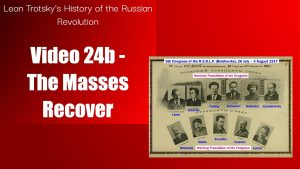
After the July Days, just such a serious analysis was vital. So, in spite of all difficulties, the planned Sixth Congress of the Bolshevik Party went ahead from July 26th, its sessions concealed in two different workers’ districts.
The congress was officially a joint congress planned to bring about the inclusion of various independent groups into the Bolsheviks. Most important of these was the ‘Mezhrayontsi’, the Petrograd inter-district organisation that Trotsky, Lunacharsky, Joffé and other revolutionaries belonged to. Trotsky writes about his own political development as follows: “It was only at this July congress that Trotsky formally joined the Bolshevik Party. The balance here was struck to years of disagreement and factional struggle. Trotsky came to Lenin as to a teacher whose power and significance he understood later than many others, but perhaps more fully than they” [Volume Two, Chapter Thirteen 13].
There were 175 delegates representing 112 organisations and 176,750 members in all. There were 36,000 Bolsheviks in Petrograd plus the 4,000 Mezhrayontsi and 1,000 in the Military Organisation. The Party had 42,000 members in the industrial regions around Moscow, 25,000 in the Urals, 15,000 in the Donetz basin and significant numbers in some of the main cities of the Caucasus.
Lenin, Trotsky, Zinoviev and Kamenev received most votes in the elections for the Central Committee although Trotsky was now in prison and the other three could not risk attending the congress. Nevertheless, Lenin’s theses formed the basis of the discussions.
Trotsky writes that “invisibly present at the congress, Lenin introduced into its work a spirit of responsibility and audacity. ... He knew that an incorrect economic formula, like an inattentive political observation, takes cruel vengeance in the hour of action. In defending his fastidiously attentive attitude to every party text, even the secondary ones, Lenin said more than once: ‘This is not a trivial detail. We must have accuracy. Our agitators will learn this and not go astray ... We have a good party,’ he would add, having in view just this serious, meticulous attitude of the rank-and-file agitator upon the question of what to say and how to say it.” [Volume Two, Chapter Thirteen 13].
Unlike April, the unity of the meeting was noticeable. The Congress, guided by Lenin’s theses, confirmed the party’s warnings against being drawn into premature conflicts but also explained the need to prepare for an armed insurrection. In doing so, the congress withdrew the central slogan of the previous period – “All Power to the Soviets”. Before the July Days, a peaceful transfer of power to the soviets, followed by the winning of a Bolshevik majority within them, had seemed possible - but no longer.
Trotsky writes: “If the Executive Committee should now have decided to introduce a resolution transferring the power into its own hands, the result would have been wholly different from … before. A Cossack regiment … would probably have entered the Tauride Palace … to arrest the ‘usurpers’. The slogan ‘Power to the Soviets’ from now on meant armed insurrection against the government and those military cliques which stood behind it. But to raise an insurrection in the cause of ‘Power to the Soviets’ when the soviets did not want [it], was obvious nonsense” [Volume Two, Chapter Thirteen 13].
The new demand would now have to be: “The candid slogan of the conquest of power by the proletariat and the peasant poor. This was not a renunciation of the soviets as such. After winning the power, the proletariat would have to organise the state upon the soviet type. But these would be other soviets … directly opposite to the defensive function of the Compromisist soviets” [Volume Two, Chapter Thirteen 13].
The Masses Recover
The industrialists had sought to take advantage of the workers’ weakness in July by going on the offensive. A key part of their strategy had been deliberate economic sabotage, closing down factories, concealing raw materials, even deliberately flooding mines and destroying machinery. But the workers had responded with a wave of strikes. While the more experienced layers held back, fresher workers like those in the textile, leather and paper industries came to the fore.
As time went on, the slander against the Bolsheviks began to lose its effect in the factories. After all, it was hard to believe your workmate was a German spy when you had known him for years. It had only taken days for the most politically advanced workplaces in Petrograd to recover. They started to mount protests against the arrests and slanders.
By the end of July, the Bolsheviks had regained their position in Petrograd’s factories and were again able to carry out agitational work in the city. Slutsky, Volodarsky and Yefdokimov toured meetings around Petrograd. The 50,000-strong ‘Union of Youth’ was also coming under increasing Bolshevik influence.
Even the soldiers soon began to wonder, as Trotsky puts it: “If the Bolsheviks are German spies, why does the news come chiefly from sources most hateful to the people … the Kadet press? Why in accusing ‘Lenin & Co.’ do they shake their fists in the very faces of soldiers, as though they were the traitors?” [Volume Two, Chapter Twelve 12].
Then, on July 21st and 22nd, just as the Compromisers and bourgeoisie were wrangling over their new coalition, a far more significant coalition began to form – between the workers and soldiers.
Delegates from the front had been arriving in the capital to try and meet with the Soviet E.C. to protest at the restoration of the old regime’s methods at the front. But the E.C. refused to meet them. Instead, encouraged by the Bolsheviks, the delegates went to discuss with the workers and soldiers of Petrograd. These discussions then led to a conference being called from below with representatives from 29 regiments at the front, 90 from Petrograd factories plus delegations from the Kronstadt sailors and other surrounding garrisons.
“The Petersburg workers listened to the men from the front eagerly. Those grey soldiers … painted in unstudied words … how everything was crawling back to the old, hateful … regime. The contrast between the hopes of yesterday and today’s reality struck home to every man there. A Bolshevik resolution was passed almost unanimously. The dispersing delegates will tell the truth about how the Compromise leaders repulsed them and the workers received them. And the trenches will believe their delegates” [Volume Two, Chapter Eleven 11].
These meetings with the representatives from the front helped the Petrograd garrison recover, although some of the regiments most to the fore in July still retained their caution and apathy. The Bolshevik Military Organisation started to get back on its feet, helped by the involvement of Sverdlov and Dzerzhinsky from the Central Committee.
The party also began to recover in Kronstadt and amongst the sailors based at Helsingfors. By August, a Bolshevik, Brekman, was elected president of the Kronstadt soviet. “The sailors had been to a considerable degree the instigators of the July movement, acting over the head of, and to an extent against the will of the party. The experience … had shown them that the question of power is not so easily solved. Semi-anarchistic moods had now given place to confidence in the party” [Volume Two, Chapter Eleven 11].
After some delay, Moscow began to take the same road as Petrograd, as soon became clear in the strength of the strike against the State Conference. Events at the Conference itself further accelerated the leftward move of the masses and the growth of the Bolsheviks.
The leftward shift of Petrograd’s Mensheviks was shown when they voted to exclude Tseretelli from their election list for the city duma. Then the city’s Social Revolutionaries voted to dissolve the reactionary League of Officers at headquarters. On August 18th, nearly all of the 900 delegates to the Petrograd Soviet voted to demand the abolition of the death penalty. Only 4 votes were cast against - the leading Compromisers, Tseretelli, Cheidze, Dan and Lieber!
The Petrograd duma elections on August 20th saw the Social Revolutionaries losing votes, although still with the largest share at 37%, the Kadets winning a fifth of the poll but the Mensheviks only on a pitiful 4%. However, to everyone’s surprise, the Bolsheviks won a third of the total poll.
Similar strides forward for the Bolsheviks were demonstrated in elections and conferences right across the country. For example, the party had recovered sufficiently in Kyiv to handsomely win a majority at a conference of factory and shop committees held on August 20th.
The Fall and Rise of the Soviets
From February onwards, despite an inevitable lagging behind and sometimes deliberate postponement of elections, the changing fortunes of the parties had been reflected in the make-up of the soviets. With increasing Bolshevik influence, came also an increasing involvement of the soviets in the direct administration and control of local industry, agriculture and justice.
By early July, many provincial soviets, such as those in the Urals, were already in effect organs of power in their localities. This was already anticipating the soviet organisation following the revolution. The July Days cut right across this development.
While the role of parties and unions still seemed clear even in a time of reaction, in the aftermath of the July Days it was unclear whether the soviets had any future at all. Instead of soviet power, control by the government and its commissars had been strengthened instead. Other functions were being transferred to the factory committees and municipalities.
Indeed, Lenin was coming to the opinion that the compromisist soviets might just wither on the vine and that it would be the Bolshevik-led factory committees that were likely to become the organs of insurrection. After all, the Moscow strike against the State Conference had been called from the factories against the opposition of the Moscow Soviet leaders.
Soviets are revolutionary bodies and, unless being used for the struggle for power, begin to lose their purpose. The Compromise leaders of many of the soviets no longer sought to use their power, giving way to the bureaucracy instead. Many soviets turned into pointless talking shops. Nevertheless, the total number of soviets was still growing, reaching 600 by the end of August, as the idea was now taking hold in more backward counties and regions.
The decline in the fortunes of the Soviet Executive Committee even allowed the government to push the E.C. out of the Tauride Palace and into the Smolny Institute.
However, in late July, a revival of the soviets had already started, from the bottom up, as the Bolsheviks began to restore their support in the districts of Petrograd. Their demands at first were limited – against mass arrests, for restoration of the Left press, an end to the disbandment of regiments and the death penalty at the front, for example.
By August, as well as in Kronstadt, the Bolsheviks were winning soviet majorities in a number of areas and more radical slogans were starting to be raised including, once again, the transfer of power to the soviets.
“After the temporary halt in its growth Bolshevism again began confidently spreading its wings. ‘The compensation is coming fast,’ wrote Trotsky in the middle of August. ‘Driven, persecuted, slandered, our party has never grown so swiftly as in recent days. And this process will not be long in running from the capital to the provinces, from the cities into the village and the army. All the toiling masses of the country will have learned, when new trials come, to unite their fate with the fate of our party’ ” [Volume Two, Chapter Twelve 12].
5. Leon Trotsky (1930) The History of the Russian Revolution: Volume Two, Chapter Five, is available at: https://www.marxists.org/archive/trotsky/1930/hrr/ch28.htm (Accessed 17 June 2026)
6. Leon Trotsky (1930) The History of the Russian Revolution: Volume Two, Chapter Six, is available at: https://www.marxists.org/archive/trotsky/1930/hrr/ch29.htm (Accessed 17 June 2026)
7. Leon Trotsky (1930) The History of the Russian Revolution: Volume Two, Chapter Seven, is available at: https://www.marxists.org/archive/trotsky/1930/hrr/ch30.htm (Accessed 17 June 2026)
8. Leon Trotsky (1930) The History of the Russian Revolution: Volume Two, Chapter Eight, is available at: https://www.marxists.org/archive/trotsky/1930/hrr/ch31.htm (Accessed 17 June 2026)
11. Leon Trotsky (1930) The History of the Russian Revolution: Volume Two, Chapter Eleven, is available at: https://www.marxists.org/archive/trotsky/1930/hrr/ch34.htm (Accessed 17 June 2026)
12. Leon Trotsky (1930) The History of the Russian Revolution: Volume Two, Chapter Twelve, is available at: https://www.marxists.org/archive/trotsky/1930/hrr/ch35.htm (Accessed 17 June 2026)
13. Leon Trotsky (1930) The History of the Russian Revolution: Volume Two, Chapter Thirteen, is available at: https://www.marxists.org/archive/trotsky/1930/hrr/ch36.htm (Accessed 17 June 2026)
Two videos summarising this lesson can be found here: https://youtu.be/r1UQiPaSb28
and here: https://youtu.be/NKWJf7eo6yc