Marxist
Education Portal

Education Portal
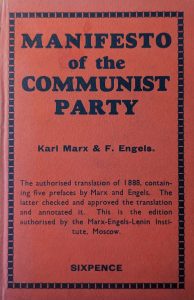
This lesson continues through Chapter One of the Communist Manifesto - ‘Bourgeois and Proletarians 14’ – moving on to a section where Marx and Engels describe how the working class creates its own independent collective organisations.
The paragraphs continue on from those highlighted in the previous lessons:
(The content has been slightly abridged to give a more concise selection of quotes)
From scattered rage to concentrated strength
“The proletariat goes through various stages of development. With its birth begins its struggle with the bourgeoisie. At first ... they direct their attacks not against the bourgeois conditions of production, but against the instruments of production themselves; they destroy imported wares that compete with their labour, they smash to pieces machinery, they set factories ablaze, they seek to restore by force the vanished status of the workman of the Middle Ages.
Wages reduced to the same low level
At this stage, the labourers still form an incoherent mass scattered over the whole country, and broken up by their mutual competition. ... But with the development of industry, the proletariat not only increases in number; it becomes concentrated in greater masses, its strength grows, and it feels that strength more. The various interests and conditions of life within the ranks of the proletariat are more and more equalised, in proportion as machinery obliterates all distinctions of labour, and nearly everywhere reduces wages to the same low level”.
Trade union struggle is victorious ‘now and then’
“The growing competition among the bourgeois, and the resulting commercial crises, make the wages of the workers ever more fluctuating. The increasing improvement of machinery, ever more rapidly developing, makes their livelihood more and more precarious; the collisions between individual workmen and individual bourgeois take more and more the character of collisions between two classes.
Thereupon, the workers begin to form combinations (Trades’ Unions) against the bourgeois; they club together in order to keep up the rate of wages; they found permanent associations in order to make provision beforehand for these occasional revolts. … Now and then the workers are victorious, but only for a time. The real fruit of their battles lies, not in the immediate result, but in the ever-expanding union of the workers.
This union is helped on by the improved means of communication that are created by modern industry, and that place the workers of different localities in contact with one another. It was just this contact that was needed to centralise the numerous local struggles, all of the same character, into one national struggle between classes”.
14. Karl Marx and Friedrich Engels (1848) Manifesto of the Communist Party, Chapter 1. Available at https://www.marxists.org/archive/marx/works/1848/communist-manifesto/ch01.htm#007 (Accessed 22 August 2026).
22. Oxfam (2026) Global Inequality Report. Available at https://www.oxfam.org.uk/get-involved/campaign-with-oxfam/fight-inequality/oxfams-global-inequality-report/ (Accessed 30 August 2026).