Marxist
Education Portal

Education Portal
This lesson focuses on just one key phrase from the 1872 Preface to the Communist Manifesto 9, that: ‘the working class cannot simply lay hold of ready-made state machinery and wield it for its own purposes’.
One brief sentence in the 1872 Preface to the Communist Manifesto is of such significance that it serves as a starting point for a lesson of its own! It is an insight which could not have been included in the original Manifesto, because it was one that arose not from theory, but from experience - specifically the experience of the 1871 Paris Commune. This had been analysed by Marx in more detail in other writings.
From Marx and Engels’ Preface to the 1872 German Edition 9:
“One thing especially was proved by the [Paris] Commune [of 1871] – ‘the working class cannot simply lay hold of ready-made state machinery and wield it for its own purposes’. (See The Civil War in France: Address of the General Council of the International Working Men’ s Association 1871, where this point is further developed.).”
The following passages are selections from that ‘Address to the International Workingmen’s Association 10’, given by Marx in May 1871, highlighted in the 1872 Preface above:
“‘The proletarians of Paris,’ said the Central Committee in its manifesto of March 18, ‘amidst the failures and treasons of the ruling classes, have understood that the hour has struck for them to save the situation by taking into their own hands the direction of public affairs...’
But the working class cannot simply lay hold of the ready-made state machinery and wield it for its own purposes.
… Paris ... the social stronghold of the French working class ... could resist only because, in consequence of the siege [by the Prussian army] ... it had got rid of the army, and replaced it by a National Guard, the bulk of which consisted of working men. This fact was now to be transformed into an institution. The first decree of the Commune, therefore, was the suppression of the standing army, and the substitution for it of the armed people.
The Commune was formed of the municipal councillors, chosen by universal suffrage in the various wards of the town, responsible and subject to recall at short notice. The majority of its members were naturally working men or acknowledged representatives of the working class. ...
Instead of continuing to be the agent of the Central Government, the police was at once stripped of its political attributes, and turned into the responsible, and at all times subject to recall, agent of the Commune. So were the officials of all other branches of the administration. From the members of the Commune downwards, the public service had to be done at a workman’s wage. The vested interests and the representation allowances of the high dignitaries of state disappeared along with the high dignitaries themselves. Public functions ceased to be the private property of the tools of the Central Government. Not only municipal administration, but the whole initiative hitherto exercised by the state was laid into the hands of the Commune. ...
Like the rest of public servants, magistrates and judges were to be elective, responsible, and subject to recall. ... While the merely repressive organs of the old governmental power were to be amputated, its legitimate functions were to be wrested from an authority usurping pre-eminence over society itself, and restored to the responsible agents of society. Instead of deciding once in three or six years which member of the ruling class was to misrepresent the people in Parliament, universal suffrage was to serve the people, constituted in Communes ...
Its true secret was this: It was essentially a working-class government, the product of the struggle of the producing against the appropriating class, the political form at last discovered under which to work out the economical emancipation of labour. ...
When the Paris Commune took the management of the revolution in its own hands; when plain working men for the first time dared to infringe upon the governmental privilege of their ‘natural superiors,’ and, under circumstances of unexampled difficulty, performed it at [workers’] salaries ... the old world writhed in convulsions of rage”.
6. Friedrich Engels (1888) Preface to the 1888 English Edition of the Communist Manifesto. Available at https://www.marxists.org/archive/marx/works/1848/communist-manifesto/preface.htm#preface-1888 (Accessed 22 August 2026).
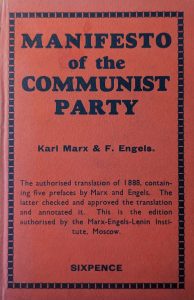
9. Karl Marx and Friedrich Engels (1872) Preface to the 1872 German Edition of the Communist Manifesto. Available at https://www.marxists.org/archive/marx/works/1848/communist-manifesto/preface.htm#preface-1872 (Accessed 22 August 2026).
10. Karl Marx (1871) The Paris Commune. Available at https://www.marxists.org/archive/marx/works/1871/civil-war-france/ch05.htm (Accessed 22 August 2026).
11. Vladimir Lenin (1917) The State and Revolution – Chapter 4. Available at: https://www.marxists.org/archive/lenin/works/1917/staterev/ch04.htm#s5 (Accessed 22 August 2026).
12. Leon Trotsky (1919) Manifesto of the Communist International to the Workers of the World. Available at: https://www.marxists.org/archive/trotsky/1924/ffyci-1/ch01.htm (Accessed 22 August 2026).
In addition, you can read more about the Rise of Stalinism in a separate course on the Marxist Education Portal: https://socialistworld.net/theory/the-rise-of-stalinism/