Marxist
Education Portal

Education Portal
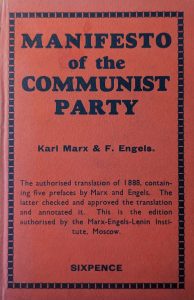
In the next sections of Chapter Two - ‘Proletarians and Communists 23’ – the Manifesto answers some of the lies and distortions thrown at the Communists back in 1848. The first one that Marx and Engels take up is one still used by our opponents today – that Communism denies ‘individuality’ and the right of ‘entrepreneurs’ to get rich but means that, instead, everyone has to live in poverty.
The paragraphs continue on from those highlighted in the previous lessons:
(The content has been abridged to give a more concise selection of quotes)
Abolishing capitalist property
“The abolition of existing property relations is not at all a distinctive feature of communism. All property relations in the past have continually been subject to historical change consequent upon the change in historical conditions. The French Revolution, for example, abolished feudal property in favour of bourgeois property. The distinguishing feature of Communism is not the abolition of property generally, but the abolition of bourgeois property …”.
To enrich not impoverish working people
“We Communists have been reproached with the desire of abolishing the right of personally acquiring property as the fruit of a man’s own labour, which property is alleged to be the groundwork of all personal freedom, activity and independence. … We by no means intend to abolish this personal appropriation of the products of labour … all that we want to do away with is the miserable character of this appropriation, under which the labourer lives merely to increase capital, and is allowed to live only in so far as the interest of the ruling class requires it. In bourgeois society, living labour is but a means to increase accumulated labour. In Communist society, accumulated labour is but a means to widen, to enrich, to promote the existence of the labourer … .”
Abolishing the right to exploit
“From the moment when labour can no longer be converted into capital, money, or rent, into a social power capable of being monopolised, i.e., from the moment when individual property can no longer be transformed into bourgeois property, into capital, from that moment, you say, individuality vanishes. You must, therefore, confess that by ‘individual’ you mean no other person than the bourgeois, than the middle-class owner of property. This person must, indeed, be swept out of the way, and made impossible.
Communism deprives no man of the power to appropriate the products of society; all that it does is to deprive him of the power to subjugate the labour of others by means of such appropriations”.
23. Karl Marx and Friedrich Engels (1848) Manifesto of the Communist Party, Chapter 2. Available at https://www.marxists.org/archive/marx/works/1848/communist-manifesto/ch02.htm (Accessed 30 August 2026).