Marxist
Education Portal

Education Portal
This lesson picks out some of the important ideas contained in the various introductory prefaces usually published alongside the original Communist Manifesto.
Most published copies of the Communist Manifesto start with a collection of the various different prefaces written by Marx and Engels as introductions to new editions of the Manifesto as they were being published, and republished, in a number of different languages. It’s not absolutely necessary to read them all in full, but nor should they just be skipped over completely, since they contain important insights and updates to the original text of the Manifesto. This lesson draws out some key points included in these introductory prefaces, particularly from the most useful one to read, the 1888 Preface to the English Edition. [A separate lesson - Lesson Four - discusses the points raised by Marx and Engels about the 'State' in the Preface to the 1872 German Edition].
Six key passages from these prefaces are posted below. In the following section there are accompanying questions prompting you to discuss what each one means, and what relevance the point being made still has for socialists today:
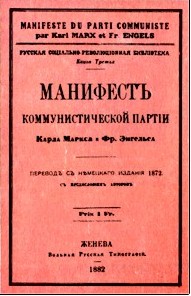
1. From Marx and Engels’ Preface to the 1882 Russian Edition 5:
Workers in less developed countries don’t have to wait for socialist revolutions to succeed in the developed ‘West’ before embarking on a revolution of their own:
“The Communist Manifesto had, as its object, the proclamation of the inevitable impending dissolution of modern bourgeois property. But in Russia we find, face-to-face with the rapidly flowering capitalist swindle and bourgeois property, just beginning to develop, more than half the land owned in common by the peasants. Now the question is: can the Russian obshchina [the peasant village commune], though greatly undermined, yet a form of primaeval common ownership of land, pass directly to the higher form of Communist common ownership? Or, on the contrary, must it first pass through the same process of dissolution such as constitutes the historical evolution of the West?
The only answer to that possible today is this: If the Russian Revolution becomes the signal for a proletarian revolution in the West, so that both complement each other, the present Russian common ownership of land may serve as the starting point for a communist development”.
2. From Engels’ Preface to the 1888 English Edition 6:
Marx and Engels had experience of fighting for their ideas in broader workers’ organisations, as well as sometimes having to battle ‘against the stream’:
“The Manifesto was published as the platform of the Communist League, a working men’s association, first exclusively German, later on international ... The defeat of the Parisian insurrection of June 1848 – the first great battle between proletariat and bourgeoisie – drove again into the background, for a time, the social and political aspirations of the European working class. Thenceforth, the struggle for supremacy was, again ... solely between different sections of the propertied class ... Wherever independent proletarian movements continued to show signs of life, they were ruthlessly hunted down. …
When the European workers had recovered sufficient strength for another attack on the ruling classes, the International Working Men’ s Association [also known as the ‘First International’] sprang up. But this association, formed with the express aim of welding into one body the whole militant proletariat of Europe and America, could not at once proclaim the principles laid down in the Manifesto. The International was bound to have a programme broad enough to be acceptable to the English trade unions, to the followers of Proudhon [anarchists] in France, Belgium, Italy, and Spain, and to the Lassalleans in Germany. [Engels adds as a footnote that, while claiming to be a Marxist, in public agitation, Lassalle ‘did not go beyond demanding co-operative workshops supported by state credit’.]
The International, on its breaking in 1874, left the workers quite different men from what it found them in 1864. Proudhonism in France, Lassalleanism in Germany, were dying out, and even the conservative English trade unions, though most of them had long since severed their connection with the International, were gradually advancing towards that point at which, last year at Swansea [in 1887], their president [Bevan] could say in their name: ‘Continental socialism has lost its terror for us.’ In fact, the principles of the Manifesto had made considerable headway among the working men of all countries.
The Manifesto itself came thus to the front again ... at present, it is doubtless the most widespread, the most international production of all socialist literature, the common platform acknowledged by millions of working men from Siberia to California.”
3. Also from Engels’ Preface to the 1888 English Edition 6:
Marxists are confident that workers will, through experience and discussion of their struggles, turn to socialist ideas:
“Marx, who drew up this programme to the satisfaction of all parties, entirely trusted to the intellectual development of the working class, which was sure to result from combined action and mutual discussion. The very events and vicissitudes in the struggle against capital, the defeats even more than the victories, could not help bringing home to men’ s minds the insufficiency of their various favourite nostrums [fake medicines that promise to cure all your illnesses] and preparing the way for a more complete insight into the true conditions for working-class emancipation. And Marx was right”.
4. Again from Engels’ Preface to the 1888 English Edition 6:
Marx and Engels looked to the revolutionary potential of the working class, not middle-class reformist ‘socialists’ who just wanted to tinker with capitalism:
“When it was written, we could not have called it a socialist manifesto. By Socialists, in 1847, were understood, on the one hand the adherents of the various Utopian systems: Owenites in England, Fourierists in France, both of them already reduced to the position of mere sects, and gradually dying out; on the other hand, the most multifarious social quacks who, by all manner of tinkering, professed to redress, without any danger to capital and profit, all sorts of social grievances, in both cases men outside the working-class movement, and looking rather to the ‘educated’ classes for support. Whatever portion of the working class had become convinced of the insufficiency of mere political revolutions, and had proclaimed the necessity of total social change, called itself Communist. It was a crude, rough-hewn, purely instinctive sort of communism; still, it touched the cardinal point and was powerful enough amongst the working class to produce the Utopian communism of Cabet in France, and of Weitling in Germany. Thus, in 1847, socialism was a middle-class movement, communism a working-class movement. Socialism was, on the Continent at least, ‘respectable’; communism was the very opposite. And as our notion, from the very beginning, was that ‘the emancipation of the workers must be the act of the working class itself,’ there could be no doubt as to which of the two names we must take. Moreover, we have, ever since, been far from repudiating it.”
5. Once again from Engels’ Preface to the 1888 English Edition 6:
History is a history of class struggle:
“The Manifesto being our joint production, I consider myself bound to state that the fundamental proposition which forms the nucleus belongs to Marx. That proposition is:
That in every historical epoch, the prevailing mode of economic production and exchange, and the social organisation necessarily following from it, form the basis upon which it is built up, and from that which alone can be explained the political and intellectual history of that epoch;
That consequently the whole history of mankind (since the dissolution of primitive tribal society, holding land in common ownership) has been a history of class struggles, contests between exploiting and exploited, ruling and oppressed classes;
That the history of these class struggles forms a series of evolutions in which, nowadays, a stage has been reached where the exploited and oppressed class – the proletariat – cannot attain its emancipation from the sway of the exploiting and ruling class – the bourgeoisie – without, at the same time, and once and for all, emancipating society at large from all exploitation, oppression, class distinction, and class struggles.
This proposition, which, in my opinion, is destined to do for history what Darwin’ s theory has done for biology, we both of us, had been gradually approaching for some years before 1845. How far I had independently progressed towards it is best shown by my ‘Conditions of the Working Class in England 7.’ But when I again met Marx at Brussels, in spring 1845, he had it already worked out and put it before me in terms almost as clear as those in which I have stated it here”.
6. Finally from Engels’ Preface to the 1888 English Edition 6:
How should the Communist Manifesto be read to make it applicable to today?
“From our joint preface to the German edition of 1872, I quote the following: ‘However much that state of things may have altered during the last twenty-five years, the general principles laid down in the Manifesto are, on the whole, as correct today as ever. Here and there, some detail might be improved. The practical application of the principles will depend, as the Manifesto itself states, everywhere and at all times, on the historical conditions for the time being existing, and, for that reason, no special stress is laid on the revolutionary measures proposed at the end of Section II [The list of ten demands in the section ‘Proletarians and Communists’ of the original Manifesto which set out ‘What We Stand For’ for the Communist League of 1848]. That passage would, in many respects, be very differently worded today. In view of the gigantic strides of Modern Industry since 1848, and of the accompanying improved and extended organisation of the working class, in view of the practical experience gained, first in the February Revolution [of France, 1848], and then, still more, in the Paris Commune [of 1871], where the proletariat for the first time held political power for two whole months, this programme has in some details been antiquated ... But then, the Manifesto has become a historical document which we have no longer any right to alter.’ ”
5. Karl Marx and Friedrich Engels (1882) Preface to the 1882 Russian Edition of the Communist Manifesto. Available at https://www.marxists.org/archive/marx/works/1848/communist-manifesto/preface.htm#preface-1882 (Accessed 22 August 2026).
6. Friedrich Engels (1888) Preface to the 1888 English Edition of the Communist Manifesto. Available at https://www.marxists.org/archive/marx/works/1848/communist-manifesto/preface.htm#preface-1888 (Accessed 22 August 2026).
7. Friedrich Engels (1845) The Condition of the Working Class in England. Available at https://www.marxists.org/archive/marx/works/1845/condition-working-class/ (Accessed 22 August 2026).
8. Friedrich Engels (1890) Letter to J. Bloch. Available at: https://www.marxists.org/archive/marx/works/1890/letters/90_09_21.htm (Accessed 22 August 2026).