Marxist
Education Portal

Education Portal
Find out how and why:
Note: This course is based on a pamphlet written in 1987 by George Collins, then a member of the South African section of the Committee for a Workers’ International, “How the Bureaucracy Seized Power“. These lessons are created by Martin Powell-Davies, Socialist Party (England & Wales) member, teacher and former leading education trade unionist.
Before looking at how Stalinism arose, let’s start with the October 1917 Russian Revolution and the decisions taken by genuine Bolshevism in order to, in Lenin’s words, “proceed to construct the socialist order”.
Petrograd, capital of Russia, on the night of October 25, 1917 (November 7 in the modern calendar). With the First World War raging on the battlefields of Europe, the Russian revolution has reached its deciding moment. Armed detachments of workers and soldiers, organized by the Bolshevik Party, have taken control in the city. The pro-capitalist Provisional Government, discredited and isolated, has ceased to exist.
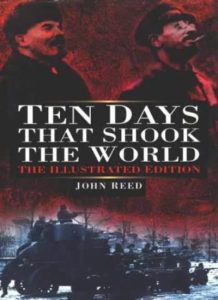
In the Smolny Institute, formerly a girls’ school, the Congress of Soviets [elected councils] of Workers’ and Soldiers’ Deputies is in session. The vast majority of delegates are representatives of the ordinary working people: “great masses of shabby soldiers, grimy workmen, peasants – poor men, bent and scarred in the brute struggle for existence” (John Reed, Ten Days That Shook the World, p.123) (MIA link to read the book)
Amidst tumultuous applause, the Bolsheviks announce the transfer of state power to the soviets of the working people. A “Proclamation to workers, soldiers and peasants”, put forward by the Bolsheviks, is overwhelmingly adopted. It sums up the immediate tasks:
“The Soviet authority will at once propose an immediate democratic peace to all nations, and an immediate truce on all fronts. It will assure the free transfer of landlord, crown and monastery lands to the Land Committees [elected by the peasants as instruments for seizing the landlords’ estates], defend the soldiers’ rights, enforcing a complete democratisation of the Army, establish workers’ control over production, … take means to supply bread to the cities and articles of first necessity to the villages, and secure to all nationalities living in Russia a real right to independent existence.
“The Congress resolves: that all local power shall be transferred to the Soviets of Workers’, Soldiers’ and Peasants’ Deputies, which must enforce revolutionary order.” (Ten Days That Shook the World, p. 115)
Lenin addressed the Congress of the following evening. When eventually he could make himself heard above the thunderous applause, his first words were to confirm the task which the democratic revolution had placed on the agenda: “We shall now proceed to construct the socialist order.”
Leon Trotsky, next to Lenin the most authoritative leader of the Russian revolution, spoke later that same night: “We rest all our hope on the possibility that our revolution will unleash the European revolution. If the insurrectionary peoples of Europe do not crush imperialism, then we will be crushed… Either the Russian revolution will raise the whirlwind of struggle in the west, or the capitalists of all countries will crush our revolution.” (Trotsky, History of the Russian Revolution, Volume 3, Chapter X) (MIA link to read the book)
The delegates, wrote John Reed, greeted these words “with an immense crusading acclaim”. Clearly, Lenin and Trotsky had expressed the thoughts and feelings of the vast majority of revolutionary fighters present that night.
Thus, in its very first hours, the new workers’ regime reasserted two fundamental propositions of Marxism – no longer as theoretical concepts but as the basis for state policy:
(a) democracy and a solution to the land question, in an underdeveloped country like Russia, is possible only under working-class rule, bringing with it the overthrow of capitalism and the transition to socialism.
(b) Socialist revolution cannot be confined within the borders of one country; it can only advance through the struggle to overthrow capitalism on a world scale.
READ and DISCUSS: Three Concepts of the Russian Revolution
“The social relations of Russia have ripened only for a bourgeois (capitalist) revolution … Objective historical conditions doom our working class to an inevitable collaboration with the capitalist class in the struggle against our common enemy.” (Axelrod, for the ‘Mensheviks’, at the 1906 Congress of the Russian Social Democratic Labour Party)
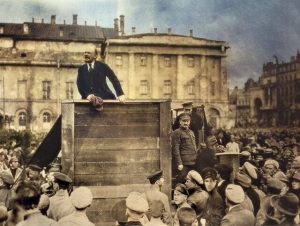
“The Russian revolution can achieve victory by its own efforts, but it cannot possibly hold and consolidate its gains by its own strength … unless there is a Socialist revolution in the West. Without this condition restoration is inevitable … for the small proprietor will inevitably turn against the proletariat.” (Lenin, for the ‘Bolsheviks’ at the 1906 RSDLP Congress) (The Unity Congress of the RSDLP Lenin)
“Left to its own resources, the working class of Russia will inevitably be crushed by the counter-revolution the moment the peasantry turns its back on it. It will have no alternative but to link the fate of its political rule, and, hence, the fate of the whole Russian revolution, with the fate of the socialist revolution in Europe”. (Trotsky, ‘Results and Prospects’, 1906) (MIA link to read the book)
a) Looking at these three quotes from 1906, and the section above:
1. How did the Menshevik view differ from that of Lenin and Trotsky?
2. What did Lenin and Trotsky fear would happen if the Russian revolution was left isolated?
b) Looking at this article by Trotsky, published in 1942, two years after his murder by a Stalinist agent:
“Without the aid of the proletarian revolution in the West, Lenin repeated, restoration in Russia was inevitable. He was not mistaken: the Stalinist bureaucracy is nothing else than the first stage of bourgeois restoration” ( Read the article here )
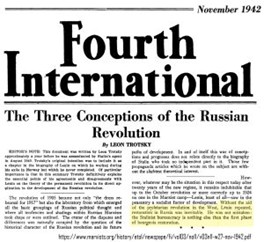
3. What does Trotsky say that Lenin warned would happen if the Russian Revolution wasn’t followed by further socialist revolutions in the ‘west’ ?