Marxist
Education Portal

Education Portal
The isolation of the Soviet Union had enabled the bureaucracy to seize power. The party's commitment to revolutionary internationalism - defended above all by Trotsky – threatened the bureaucracy’s ability to consolidate their power and privileges. In 1924-5, it was therefore abandoned in favour of the ‘theory’ of building ‘socialism in one country’.
With the defeat of the German revolution, it became clear that the Soviet Union faced a period of prolonged isolation. Abandoning any perspective of world revolution, the bureaucracy instead settled down to the “practical” task of managing the Soviet Union in the midst of a capitalist world.
Stalin produced a “theory” which reflected the conservatism of the Soviet bureaucracy. On the strength of three quotations plucked from Lenin’s voluminous writings, Stalin in December 1924 put forward the unheard-of idea that socialism could be built in Russia without the victory of the working class in the developed countries – an idea that went counter to everything Lenin had tried to explain, even in the documents Stalin quoted.
“Single-handed, the Russian proletariat cannot bring the socialist revolution to a victorious conclusion. But it can give the Russian revolution a mighty sweep that would create the most favourable conditions for a socialist revolution, and would, in a sense, start it. It can facilitate the rise of a situation in which its chief, its most trustworthy and reliable ally, the European and American socialist proletariat, could join the decisive battles.” (Lenin, Farewell Letter to the Swiss Workers, March 1917). (Full text)
Marxism has always explained that the necessity for socialism arises out of the obstacles created by the capitalist system to the further development of the productive forces. The historical purpose of socialism is to develop society beyond the economic and political limits of capitalism, to new levels of abundance and freedom. Socialist transformation frees production from the anarchy of market forces, the distortions of private ownership and the limits of national states. It liberates the collective ingenuity and creativity of the mass of working people from the repressive discipline of capitalist production.
Why can this transformation not be carried through within the borders of one country? Precisely because capitalism has developed as a world system. The most advanced productive forces are not contained in any single country; they depend on the combined efforts of the working class in a whole series of countries, tied together through world trade. Certainly, they could not exist in an economically underdeveloped country, such as Russia in 1917.
As late as April 1924, Stalin himself had still preached the exact opposite of “socialism in one country”: “For the overthrow of the bourgeoisie, the efforts of one country are enough – to this the history of our own revolution testifies. For the final victory of socialism, for the organization of socialist production, the efforts of one country, especially a peasant country like ours, are not enough – for this we must have the efforts of the proletarians of several advanced countries.” (Stalin, in an edition of his ‘Foundations of Leninism’ that was then removed from circulation!)
But, a year later, Stalin was arguing that: “Trotsky says [that] … we are not in a position, by our own efforts to overcome the internal contradictions in our country … because, it appears, only as a result of a world revolution, and only on the basis of a world revolution, can we eliminate those contradictions and, at last, build socialism. Needless to say, this proposition has nothing in common with Leninism. … Anyone who denies the possibility of building socialism in one country must necessarily deny that the October Revolution was justified.” (Stalin, speaking in May 1925) (Full text)
By this time, the triumvirate was breaking up. Its purpose had been accomplished. Zinoviev and Kamenev had joined forces with the mediocre Stalin out of hostility towards Trotsky; now they recoiled from the ruthless Stalin who had taken virtually all power into his own hands. At the party congress in December 1925, Zinoviev and Kamenev began to raise questions about Stalin’s new ‘theory’.
It was instead Bukharin who became its chief propagandist. He put it like this: “If we knew in advance that we are not equal to the task, then why the devil did we have to make the October revolution? If we have managed for eight years, why should we not manage in the ninth, tenth or fortieth year?”
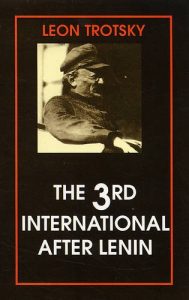
Trotsky answered these false arguments by returning to the fundamentals of Marxism: “By drawing countries economically closer to one another and levelling out their stages of development, capitalism, however, operates by methods of its own, that is to say, by anarchistic methods which constantly undermine its own work … developing some parts of world economy while hampering and throwing back the development of others. … Marx and Engels, even prior to the imperialist epoch, had arrived at the conclusion that on the one hand, [this] unevenness … stretches the proletarian revolution through an entire epoch in the course of which nations will enter the revolutionary flood one after another; while, on the other hand, the organic interdependence of the several countries, developing toward an international division of labour, excludes the possibility of building socialism in one country. This means that the Marxian doctrine, which proposes that the socialist revolution can begin only on a national basis, while the building of socialism in one country is impossible, has been rendered doubly and trebly true, all the more so now, in the modern epoch when imperialism has developed, deepened, and sharpened both, of these antagonistic tendencies. …. We have always maintained that capitalism is incapable of controlling the productive forces it itself develops and that only socialism is capable of incorporating the productive forces which have outgrown the boundaries of capitalist states within a higher economic entity”. (Trotsky, The Third International After Lenin, 1928) (Full text)
What made Stalin turn his ideas upside-down? Basically, it was the changing balance of forces that emboldened the non-theorist Stalin to throw down the gauntlet to all the theorists of Marxism. Stalin’s thoroughly dishonest argument was not a theory in the true sense of the word (an attempt at explaining reality). It was nothing more than an attempt at burying the program of permanent revolution, of Marxism itself.
Taken to its conclusions, Stalin’s “theory” denied the need for a revolutionary International. Defence of “socialism” in the Soviet Union, in contrast to the building of socialism through world revolution, now became the primary task of the Communist parties internationally. In practice, this meant uncritical support for the policies and national interests of the Soviet bureaucracy. In 1943, Stalin himself confirmed this in the most blatant manner when he dissolved the Comintern – by then a bureaucratic shell – at the stroke of a pen, in order to prove to his wartime allies, the imperialist leaders Roosevelt and Churchill, that the Soviet leadership had abandoned all thought of world revolution.