Marxist
Education Portal

Education Portal
As was only to be expected, the capitalist powers were never going to accept the overthrow of their rule in Russia without a fight. In this section, let's look at how the forces of reaction tried to crush the revolution, both militarily and economically.
As was only to be expected, the capitalist powers were never going to accept the overthrow of their rule in Russia without a fight. In this section, let’s look at how the forces of reaction tried to crush the revolution, both militarily and economically.
a) Economic Sabotage
Marx and Engels had thought it most likely that capitalism would be defeated first in the developed countries, where the working class was most powerful, and the industrial basis existed for the transition to socialism. Instead, in October 1917, the chain of world capitalism broke at its weakest link. The Bolshevik government inherited a backward society in a state of disintegration, exhausted by three years of war and a series of crushing defeats by Germany.
Within Russia, the privileged and reactionary classes, as well as reformists in the labour movement, fought the revolution with every means at their disposal – boycotts, economic sabotage, even the threat of a general strike.
Hunger worsened in the cities as food supplies came almost to a standstill: when manufactured goods could not be obtained even by barter, why should the peasants raise food for the urban market?
Committees of the poor peasants, and armed detachments of workers, were organized to seize the grain supplies hoarded by the ‘kulaks’, the rich peasants.
Workers’ control over production, through a system of factory, regional and national committees, was proclaimed to provide some check on the capitalists’ activities. But there was no way of peacefully regulating the eruption of class struggle unleashed by the revolution.
On the one hand, the capitalists refused to submit to workers’ control. On the other hand, where the workers asserted their power, they did not stop at ‘controlling’ the capitalists. They took over factories lock, stock and barrel, even before their government was able to provide them with back-up and resources.
The banks, in the face of their persistent sabotage, were occupied and nationalised in December 1917. The workers spontaneously took over more and more factories until the decree of June 1918 bringing every important branch of industry into state ownership.
b) Military Intervention
The imperialists could not tolerate the challenge to their authority, and the threat to their interests in Russia, which the Bolsheviks presented.
Armed counter-revolution began to emerge, based on an alliance of the imperialist powers with the kulaks, the capitalists, and the remnants of the forces of Tsarism. The Russian civil war raged, with peaks and intervals, from May 1918 until the spring of 1921.
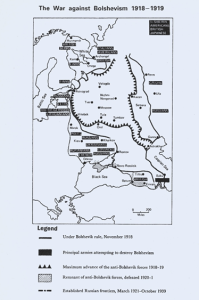
In March 1918, British forces occupied the northern port of Murmansk, and in August they seized Archangel, cutting off Russia\’s outlets to the sea. In April, Japanese troops landed at Vladivostok in Eastern Siberia.
Right-wing ‘socialists’, ex-revolutionaries and reformists, including Mensheviks and the right-wing of the ‘SRs’ – the main peasant-based party, the Social Revolutionaries – in large numbers joined the onslaught against the workers’ state. In Samara, the Right SRs set up an anti-Bolshevik ‘government’ and started to raise an army. In August they captured Kazan.
The Left SRs, based on the poor peasantry, were in coalition with the Bolsheviks until March 1918, when they left the revolutionary government. This was because they opposed the ‘Brest-Litovsk’ treaty that had been signed in order to secure the end of the war with Germany, calling it a “betrayal”. Now they plotted against the government and tried to provoke a German attack which, they believed, would be met with ‘revolutionary war’. Totally misreading the situation, they staged an insurrection in July, which rapidly collapsed.
The Western powers, as their war against Germany neared its end, concentrated their attention on Russia. More British, French and US troops were landed in Murmansk and Archangel. American, Japanese, British, French and Italian troops occupied Vladivostok and advanced westward as far as the Ural Mountains. Sizeable French forces were deployed in the Black Sea. At the same time, the imperialists financed and armed the counter-revolutionary (“White”) armies organised out of the most backward peasantry by ex-Tsarist officers.
Victor Serge, who had joined the Bolsheviks, in his book ‘From Lenin to Stalin’ (Read here) describes the desperate situation in October 1919:
“The Whites under Admiral Kolchak are masters of Siberia; they constitute the ‘supreme government’ of Ukraine under General Denikin who is preparing for a march on Moscow. In the North, thanks to the British battalions, they dominate a vaguely ‘socialist’ government … and General Yudenich is preparing to take Petrograd, where the people are dying of hunger in the streets and dead horses are piled up in front of the Grand Opera.” [see map].
Yet, a year later, the military threat had been effectively ended. The Bolsheviks’ victory over the combined forces of internal and external reaction, from a position of terrible weakness, most surely rank as one of the most brilliant military achievements of all time.