Marxist
Education Portal

Education Portal
The Bolsheviks were threatened by the military intervention of major world powers, the forces of Tsarist reaction and by capitalist economic sabotage – and yet they emerged victorious. How was this victory won?
a) International Solidarity
The survival of the Russian workers’ state was made possible, in the first place, by the support of the working class internationally in the enormous movements following the October revolution. The spirit of international solidarity was the Russian workers’ most potent weapon. Not by moral appeals to ‘democracy’ or the ‘conscience’ of the capitalist class, but by linking themselves to the working-class struggle for power internationally, the Bolsheviks won immeasurable support from every corner of the globe and opened a ‘second front’ in the imperialists’ rear.
Brilliantly confirming the Bolsheviks’ perspective, Europe was plunged into a period of revolution. The road to victory opened up before the working class in one country after another. The imperialists, tied down by life-and-death struggles in their own countries, could not continue their attacks on Russia without provoking the workers even further, and driving their soldiers to mutiny.
A strike by Hungarian munitions workers in January 1918 spread like wildfire to Vienna, Berlin and throughout Germany, involving over two million workers. Their central demand, echoing the Russian workers’ demand, was peace. In Finland, an Independent Workers’ Republic was proclaimed. After months of fighting it was crushed with the help of German troops. Then, on 4 November 1918, mutiny broke out at the German naval base of Kiel and ignited the German revolution. Within days every major city was in the hands of the workers’ councils.
In Austria, mass strikes and army mutinies finally smashed the imperial Hapsburg regime. The empire disintegrated, and in Hungary a revolutionary soviet government took power in March 1919. France was swept by mass strikes and naval mutiny. British soldiers mutinied, and the Red Flag was hoisted over the Clyde in the Scottish industrial heartland. Ireland was in armed revolt against British rule. Strikes involving four million workers convulsed the USA in 1919.
Addressed in a comradely way, British and American troops in Russia began to mutiny. On the Black Sea, French sailors hoisted the Red Flag. The imperialists were compelled to withdraw their forces and abandon the ‘Whites’ to their fate.
The early congresses of the Communist International called on the workers’ movement internationally to take action against any kind of support for the Whites in Russia. In July 1920, following the invasion of Russia by reactionary Polish forces, dockers in Britain rallied magnificently to their comrades in Russia when they refused to load the vessel ‘Jolly George’ with arms for the Whites in Poland.
In July, with the Red Army driving back the invaders, the British government threatened to send troops to Poland. Councils of action were set up by trade unionists throughout Britain, threatening a general strike if the intervention went ahead. The British government swiftly backed down.
b) The Revolutionary Army
On the battlefields of Russia, as in the international arena, the workers’ victory was only made possible by the Bolsheviks’ uncompromising revolutionary policy. Leon Trotsky, as Commissar for War from 1918 to 1924, played a vital role in organising the Red Army as a revolutionary army, motivated by political understanding, not by blind obedience.
Trotsky’s unshakeable confidence in the workers, youth and peasants who made up its ranks is best expressed in his own words: “What was needed for [saving the revolution]? Very little. The front ranks of the masses had to realise the mortal danger in the situation. The first requisite for success was to hide nothing, our weaknesses least of all; not to trifle with the masses but to call everything by its right name. … The Soviets, the party, the trades unions, all devoted themselves to raising new detachments, and sent thousands of communists to the [front]. Most of the youth of the party did not know how to handle arms, but they had the will to win, and that was the most important thing. They put backbone into the soft body of the army. … The strongest cement in the new army was the ideas of the October revolution.” (Trotsky, ‘My Life’) (MiA link to read this book)
Dedicated young workers were attracted to the army and became its vanguard. How to use arms can be learned in a short time. But the will to win can only be born out of a sense of purpose, a clear goal to fight for, and the understanding of how it can be achieved. The Bolsheviks had the morale to win; and precisely this vital force was missing from the ranks of the Whites.
As even pro-capitalist historians have to admit: “Until Wrangel took over the remnants of the White Army [i.e., nearly at the end of the war], its officers set an example of drunkenness, looting and violence which their soldiers willingly followed. Outrageous treatment of the local population, the outspoken intention to restore the landlords, and the greater social cleavage between the Whites and the peasantry made the latter finally prefer the Reds.” (JN Westwood, Russia 1917 to 1964) (Get this book here )
READ and DISCUSS:
1. These events demonstrate how a successful workers’ revolution provoked capitalist reaction but, at the same time, inspired workers in other countries to come to its defence and follow its example. What do you think would be the international impact of a successful workers’ revolution in your country?
2. Read this leaflet addressed to British soldiers in Mourmansk by the Bolsheviks in 1918. Do you think a similar appeal would work today? What wording would you put on a leaflet?
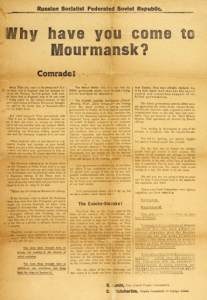
“The English capitalist newspapers Times, Morning Post, Daily Telegraph are writing every day about erecting a strong resolute government in Russia. Do these papers represent the views of democracy, or do they represent the views of the financiers, capitalists, and profiteers or England? These papers also constantly refer to the wealth of timber contained in our northern territory, which they say would be sufficient to pay for the loans which the financiers, capitalists and profiteers leant to a corrupt and tyrannical Tsarism.
Capitalists and financiers are not the friends of English workers, nor Russian workers, nor the workers of any country. Who controls the government of England today? The workers or the financial oligarchy? The financial oligarchy. They are ordering and directing your landing in Mourmansk.
Comrades! Englishmen! You who pride yourselves on your love of liberty! Descendants of the great chartists! You who have always expressed sympathy with the Russian revolution. Are you going to assist in crushing the first effort of working people to free themselves from their exploiters?
Remember this! If the Russian revolution is crushed, then the power of the capitalists will be enormously strengthened in every country, and the fight for economic freedom will be put back a hundred years”.
3. What ‘weapons’ did the Red Army have that the ‘White’ armies did not possess?