Marxist
Education Portal

Education Portal
The Bolsheviks saw their revolutionary victory as a ‘spark’ that would help ignite mighty working-class movements that could overthrow capitalism in the developed countries of Europe. Such victories would, in turn, provide a basis for overcoming Russia\'s crippling economic backwardness, made worse by the civil war, and remove the threat of further imperialist attack.
a) The First and Second Internationals
From Marx and Engels onwards, revolutionary Marxists recognised that international organisation was essential to unite and direct the workers moving into action in different countries.
The pioneering work of Marx and Engels in trying to build the ‘First International’ in the 1860s bore fruit in the mass organisations of the working class that later developed, particularly in Germany, France and Italy, eventually leading to the establishment of the Second International in 1889.
The Second International was formed in 1889 as a federation of (mainly European) social-democratic parties, in general subscribing to Marxism. However, it was built during a period of imperialist expansion and generally stable growth in the developed capitalist countries. This had a decisive effect on its character.
Important struggles were fought under the banner of the International. Major concessions were won – democratic rights, better wages, better conditions. A skilled and relatively well-paid ‘aristocracy of labour’ was created in the process. Out of this layer, increasingly, the leadership was drawn, together with intellectuals who decided to build their careers in the labour movement.
Remote from the workers’ daily struggles, these leaders became increasingly comfortable in well-paid jobs as parliamentarians or party and trade union officials. Inevitably their ideas became affected by their surroundings. Their general mood was summed up in the theory of “reformism” – the idea that capitalism could gradually be ‘reformed’ out of existence through peaceful, parliamentary methods. The struggle to overthrow the capitalist state could then be quietly pushed into the background.
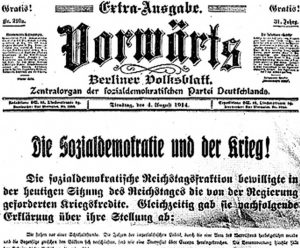
Inevitably, reformism led to increasing collaboration with the capitalist class. Labour leaders became more and more involved with various organs of the state. Public positions gave them new privileges. Through all these pressures a nationalist outlook was cultivated. Their links with the international movement were reduced to mere sentiment and phrases. When world war came in 1914, most of the leaderships of the national parties in the different warring countries deferred to ‘national unity’ and capitulated to supporting the ruling classes of their respective countries. The Second International had ceased to exist as an instrument of the workers’ struggle for power. A new International needed to be built.
b) The Third International
A historic letter was sent out early in 1919 to revolutionary workers’ organisations in different countries. It was signed by Lenin and Trotsky on behalf of the Russian Communist Party (the new name of the Bolshevik Party) and by workers’ leaders from other countries. It invited the organisations to a congress to be held in Moscow, and explained the purpose as follows: “The Congress must establish a common fighting front for the purpose of maintaining permanent coordination and systematic leadership of the movement, a centre of the communist international, subordinating the interests of the movement in each country to the common interest of the international revolution.”
At this congress, held from March 2 to 6, 1919, the Communist (Third) International was formed.
“The imperialist system is collapsing. … There is only one force able to save humanity and that is the working class. … The working class has to establish real order – Communist order. It must break the rule of capital, make wars impossible, abolish the frontiers between states, transform the whole world into a community where all work for the common good and realise the freedom and brotherhood of peoples”. (From the “Platform of the Communist International” agreed by the Congress). (Read full text here )
“The First Congress convened after the war at a time when Communism was just being born as a European movement and when there was a certain justification for reckoning and hoping that the semi-spontaneous onset of the working class might overthrow the capitalist class before the latter succeeded in finding a new orientation and new post-war points of support. Such moods and expectations were by and large justified by the objective situation at the time. … But the capitalists were able to withstand this initial onset.” (Trotsky, ‘The First Five Years of the Communist International’). (MIA link to read the full text)
“Genuine freedom and equality will be embodied in the system which the Communists are building, in which there will be no opportunity for amassing wealth at the expense of others, no objective opportunities for putting the press under the direct or indirect power of money, and no impediments … for enjoying and practising equal rights in the use of public printing presses. … The substance of Soviet government is … the mass scale organisation of the classes oppressed by capitalism … who even in the most democratic bourgeois republics, while possessing equal rights by law, have in fact been debarred by thousands of devices and ruses from participation in political life and enjoyment of democratic rights and liberties, that are now drawn into constant and unfailing, moreover, decisive, participation in the democratic administration of the state”. (Lenin’s ‘Thesis on ‘Bourgeois Democracy’, agreed by the Congress). (Read the full text here)
c) Further revolutionary movements are defeated
The inspiring advances by the working class in 1918-1919, however, marked only the beginning of a drawn-out period of revolution and counter-revolution. In the ebb and flow of class battles flaring up across Europe, the workers were unable to hold on to their early gains.
Two main factors combined to produce a series of defeats: firstly, the deliberate treachery of the social-democratic leaders; secondly, the immaturity of the revolutionary currents in the workers’ movement outside of Russia – in other words, the weakness of genuine Marxist leadership even in the parties of the Third International.
In Germany, large sections of workers still had illusions in the reformist SPD leadership. In November 1918 the reformists, headed by Noske and Scheidemann, were pushed into government as conscious agents of counter-revolution. Their strategy was to persuade the working class to accept the authority of the ‘democratic’ capitalist parliament. Then they rebuilt the armed forces of the capitalist state to break up the workers’ councils. Rosa Luxemburg and Karl Liebknecht, the outstanding revolutionary leaders in the German workers’ movement, were murdered in January 1919 in the military counter-revolution unleashed by their former party comrades. But the German capitalists remained weak, and the workers movement was far from crushed. Many more battles were yet to be fought.
The membership of the Communist International (or ‘Comintern’) leaped explosively upward. Fifty-one national sections, with a total membership of 2.8 million (only 550,000 in the USSR) were represented at the Third Congress in 1921. Many different political tendencies were drawn into the International, ranging from ‘centrism’ (i.e. standing between Marxism and reformism: revolutionary in words but vacillating in practice) to ‘ultra-leftism’.
In Hungary, it was the ultra-left mistakes of the Communist leadership that led to the defeat of the Soviet republic. Refusing to divide the land amongst the peasantry, insisting dogmatically on collectivising the landlords’ estates, they were unable to win the support of the peasant masses and unify the country. When counter-revolution struck in the form of an invasion by Romanian and Czechoslovak armies, the peasants were unwilling to fight for a government which refused their most basic demand. In August 1919, after four months of heroic resistance, the workers’ republic fell. The workers’ movement was subjected to a hideous bloodbath in the reactionary terror that followed.
In Italy, it was the centrist spinelessness of the workers’ ‘revolutionary’ leaders that made victory impossible. A massive wave of factory occupations in 1920 created a revolutionary situation, with soviets controlling the factories and Red Guards defending them. The capitalist state was paralysed. The task was to mobilize and arm the workers for the conquest of power. The ‘Marxist’ leaders of the Italian Socialist Party were forced by pressure from below to profess support for the Comintern. In fact, they were divided, and even the ‘maximalist’ (left) wing declined to lead the struggle. The initiative was allowed to pass to the reformists, who in turn handed power back to the capitalists – as usual, in return for some temporary concessions.
In France, Ireland, Britain, the Netherlands and many other countries the capitalist class managed to regain control with the assistance of the reformist labour leaders. In every case, this was possible only in the absence of a developed Marxist leadership able to seize the enormous opportunities and isolate the reformists, as the Bolsheviks had done in Russia.
By 1921 the workers’ struggle internationally was in a state of temporary ebb. A peculiar and dangerous correlation of forces was emerging: on the one hand, the capitalist class consolidating its position internationally; on the other hand, the Russian workers’ state isolated and exhausted.
READ and DISCUSS:
1.
When Lenin first saw an issue of the German SPD’s paper, Vorwärts, [pictured] supporting war, he initially thought it must be a forgery! But what were the root causes of this shattering betrayal by the leaders of the Second International?
2.
According to the Founding Congress of the Third International,
i. Which class can transform the world and put an end to wars?ii. Why was there hope that capitalism might be overthrown in other European countries even without the same kind of clear leadership that the Bolsheviks had provided in Russia?
iii. How does Soviet democracy differ from capitalist ‘bourgeois democracy’?
iv. Different groups should all be able to print their newspapers, not just those with power and wealth. What other forms of communication would you include in such democratic rights under a workers’ state today?
3.
i. What were the two main factors that meant that movements in other countries were defeated?
ii. What were the main reasons for defeat in Germany? Hungary? Italy?