Marxist
Education Portal

Education Portal
The third of the ‘three component parts’ of Marxism is its analysis of the economic processes that operate under capitalism. Such an analysis, first set out in detail by Marx, and subsequently refined and added to over 150 years of further experience, reveals that capitalism is a system beset by cyclical crises and contradictions which defy the rational planning required to meet society’s needs.
We live in a world where historically undreamt-of wealth exists, where technology has been developed in a way that was once only envisaged in science fiction, where enough food, shelter and the basics of life could be generated to satisfy the needs of every person on the planet.
Yet in this capitalist world a staggering number of the world’s population suffer from hunger, malnutrition and preventable disease, and can’t get clean water or decent housing. Even in the richest countries, millions live in poverty and insecurity. It is also a world where the methods of capitalist production threaten the world’s environment, not least through climate change.
Despite the aspirations of capitalist governments, and hundreds of years of study by pro-capitalist economists, it is crystal clear that they have no control over the economy and its repeated economic crises. Crisis is built into the DNA of capitalism.
Back in 2007, Gordon Brown, then the ‘New Labour’ chancellor of the exchequer in Britain, and later prime minister, repeated his phrase “we will never return to the old boom and bust”. Like other global leaders of former workers’ parties who had rushed to fully embrace the ‘market’ in the wake of the collapse of Stalinism, and like many other capitalist politicians before him, Brown imagined that the contradictions of the profit system had somehow been resolved. But only months later, economic crisis engulfed Britain and the world as the ‘Great Recession’ of 2007-2009 dragged the world economy under.
Mass bailouts saved the banks but plunged governments and households into greater debt. The COVID pandemic then revealed the full extent of capitalist dysfunction: underfunded health systems, broken supply chains, and governments incapable of providing a solution to the many crises of capitalism. The relative decline of U.S. imperialism has now ushered in a new geopolitical ‘disorder’ of inter-imperialist tensions, proxy wars, and rivalry between shifting trading blocs.
At the start of 2026, it is already clear that a new global downturn is looming, one which could potentially put the ‘Great Recession’ into the shade. The IMF’s ‘World Economic Outlook’, published in October 2025, concluded that the overall “outlook for the global economy continues to point to grim prospects both in the short and the long term.” They warned, amongst other things, of low growth, the dangers of protectionism, the risk of sovereign debt crises in major economies, and the threat of a financial crash should asset ‘bubbles’ – such as the “excessively optimistic growth expectations about AI” – suddenly burst.
Capitalism has always been cyclical. Today, however, it is an increasingly sick system where periods of stagnation or, at best, weak growth are interspersed with increasingly severe crises. The lease of life –based on increased exploitation of the working class – that capitalism received in the aftermath of the collapse of the Stalinist regimes over three decades ago is definitively over. We are in an era of dramatic social, political and economic polarisation, shocks, instability and uncertainty, the degree of which have not been experienced for generations.
Marxism analyses the processes that exist under capitalism, in order to explain the reason for its crisis; not as an academic exercise, but to show the necessity of an alternative to capitalism, that of socialism. The study of ‘political economy’ not only looks at economic processes, but also their link to social conditions, the class struggle, and politics. Before looking at the wider processes in capitalism, a start has to be made with some basic concepts – like those set out in the next lessons in this course.
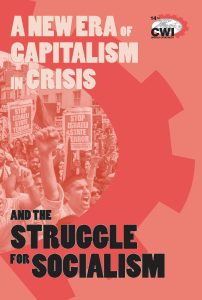
39. Committee for a Workers' International (2025) A New Era of Capitalism in Crisis and the Struggle for Socialism. Available at https://www.socialistworld.net/2025/08/19/cwi-14th-world-congress-new-era-of-capitalism-in-crisis-and-the-struggle-for-socialism/ (Accessed 24 February 2026).