Marxist
Education Portal

Education Portal
People have always sought to understand the world they live in through observing nature and trying to learn by generalising their day-to-day experiences. This is philosophy. The history of philosophy shows a division into two opposing camps – ‘idealism’ and ‘materialism’ (words that have different meanings in philosophy than when used in everyday language). ‘Materialist’ philosophy can be summed up by the understanding that ‘it is not consciousness that determines conditions, but conditions that determine consciousness’. Marxism is a materialist philosophy.
The idea that you need to look to the economy and people’s conditions of life to explain how people are thinking and acting - rather than the other way around - is more widely accepted now than it was in Marx and Engels’ time. In today’s world, most scientists and even capitalist strategists at times adopt a materialist outlook. For example, in 1992, an adviser to the US Democrats explained why the Democrats could defeat the incumbent US President George Bush with the catchphrase, ‘It’s the economy, stupid’. In other words, the experience of falling living standards turned former Republican voters away from Bush.
On the other hand, ‘idealist’ philosophies assert that thought - or consciousness - is primary and that people’s actions stem from abstract thoughts, devoid of material and historical context. It was Marx and Engels who first fully challenged this conception, explaining that an understanding of the world must start not from the ideas that exist in people’s heads in any historical period, but from the real, material conditions in which these ideas arise. The material world is real and develops through its own natural laws. Thought is a product of that material world, without which ideas cannot exist. Flowing from this, it is clear that Marxism must reject the so-called ‘eternal truths’, religious or otherwise, of idealism.
Marx and Engels based their materialism upon the ideas and practice of the great materialist philosophers of the 18th century. The growth of cultural and scientific enquiry in the previous two centuries was both a cause of, and an effect of, the early growth of capitalism. Astronomy, mechanics, physics, anatomy and physiology feverishly developed as areas of separate study, with the consequence that age-old beliefs in an inviolable God directing everything were severely undermined.
Marx declared that this enlightenment had ‘cleared men’s minds’ for the great French revolution in 1789 and the ‘age of reason’. However, Marx and Engels also explained that the mechanical materialism that developed at the start of capitalism was still too limited and one-sided in its outlook. It saw the material world as being fixed, rather than undergoing constant change.
They took inspiration from an early 19th century German philosopher, Georg Hegel. Hegel had resurrected ‘dialectical’ thinking from its Greek origins and cast light again on a long-dormant truth – that ideas and their real existence move through a series of processes. Hegel was, however, a proponent of idealism, conceiving of thought, things and their development as the realised images of a ‘supreme idea’ (God) existing somewhere universal, separate and eternal.
Marx and Engels were able to turn this confusion on its head through the fusing of the dialectic with a materialist conception of history, creating in the process ‘dialectical materialism’, the most revolutionary and far-reaching theory for both explaining, and then changing, the world.
4. Karl Marx (1859) A Contribution to the Critique of Political Economy. Available at https://www.marxists.org/archive/marx/works/1859/critique-pol-economy/preface.htm (Accessed 20 February 2026).
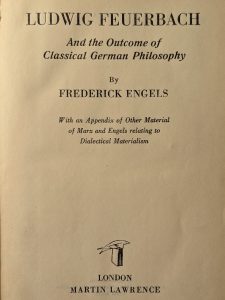
5. Frederick Engels (1886) Ludwig Feuerbach and the End of Classical German Philosophy. Available at https://www.marxists.org/archive/marx/works/1886/ludwig-feuerbach/ch02.htm (Accessed 20 February 2026).
6. Frederick Engels (1892) Socialism: Utopian and Scientific, English Edition Introduction. Available at https://www.marxists.org/archive/marx/works/1880/soc-utop/int-hist.htm (Accessed 20 February 2026).