Marxist
Education Portal

Education Portal
The next set of concepts to understand, in order to come to grips with Marxist Economics, are ‘labour power’ – the ability to work, which a worker sells as a commodity to their employer, and ‘surplus value’ - the ‘unpaid labour of the working class’, the ultimate source of capitalist profits.
Labour Power
When a worker is employed, they sell their ability to work to the boss, their ‘labour power’. The boss buys it for a specified period of time. But what the worker gets paid for that labour power, i.e. their wage, is not determined by how much value they create for a commodity or service from their labour. When a worker gets paid an hourly rate, it gives the false impression that they are paid for all the work they do during each hour and for all the value that is created by it. In fact, they aren’t!
The new value created by workers through their labour is above and beyond what they get paid. Expressed in terms of the working day, in effect they work some of the time to pay their own wage, and the rest of the time for the boss’s profits and non-wage costs. In some industries, each worker will have covered the cost of their wages well before half of their shift is completed. For the rest of the time, they are simply working for the benefit of their boss!
So, as Marx explained, profit comes from the ‘unpaid labour of the working class’. Jeff Bezos’ billions have been made because of the low pay and long hours of his Amazon workers who distribute commodities, and of the workers who make them.
Once that concept has been understood, it is easy to see why most workplace disputes are about the employer either trying to cut real wages or seeking to increase the length or intensity of the working day. Either, or both, of these outcomes will result in a larger proportion of the working day counting as ‘unpaid labour’. On the other hand, if, through collective action, workers can secure a pay rise and/or a cut in hours, then a bigger share of the value created is going to the worker who is actually producing it, and less to the boss who profits simply by being an employer.
Extrapolating this daily exploitation in the workplace to the global division of wealth, the 2022 ‘World Inequality Report’ 44 estimates that the world’s richest 0.001% (51,700 adults) owns 6.4% of global wealth. The world’s poorest 50% (2.6 billion adults) owns just 2% of that total. But the share going to that wealthy 0.001% has been increasing – in 1995 it was only 3.5%. In other words, an even greater proportion of the wealth generated by the labour of the working class is going to the super-rich.
Of course, capitalism is not the first form of society where a minority of exploiters own the ‘means of production’ so that they can profit from the labour of the exploited majority. That was true under feudalism and the slave-based societies that preceded it too. However, the exploitative relationship was much more obvious than it is under capitalism. Slaves were forced to work for only their subsistence. Serfs worked part of their time to provide agricultural products for themselves and part for the landowner. Under capitalism, the exploitation of workers can appear to be less obvious. Capitalist ideology portrays workers as free individuals who can sell their labour as they wish, in that way attempting to hide the exploitative nature of the capitalist-worker relationship.
Surplus Value
Marx described the extra ‘unpaid’ labour - above the labour necessary to pay the workers’ wages - as ‘surplus value’. That has to first pay off the business owner’s overheads, including paying rent on their premises to their landlord, and interest to the banker who loaned the money for the owner’s investment - so other sections of the capitalist class get their cut too. The remainder then becomes profit.
Despite capitalist propaganda that it is ‘entrepreneurs’ who create wealth, in fact it is created by workers. The bosses argue that they bring together the capital, i.e. money, buildings, machinery and inputs like raw materials and components. This Marx called ‘constant capital’.
All those inputs represent wealth that has previously been created by other workers. They can be viewed as crystallised labour from previous processes and do not create new value in the product being created but rather represent a transfer of value that had already been created. In that sense it is ‘dead labour’. In the case of long-term investments like machinery, a very small amount of its value is transferred to each commodity made, equivalent to the wear-out of that machinery while making it.
It is the labour of workers applied to those inputs, called ‘variable capital’ by Marx, which creates new wealth. Although the new finished commodity incorporates the past values that have gone into its production, it is from that new value added by labour that bosses can accumulate capital.
Goods and Services
The capitalist economy is of course not just about manufacturing; services are also bought and sold. These services, along with other state-owned parts of the capitalist state apparatus, are paid for through taxation, which comes directly or indirectly both from workers’ wages and from the bosses’ profits.
Anything that goes on in society that makes a profit for the capitalist is seen by them as productive. So, the work of a nurse in a public sector hospital who saves lives is viewed as ‘unproductive labour’, whereas the work of a nurse employed by a private health company is ‘productive labour’. Publicly owned health services, welfare states, and universal free education, were won through the pressure and struggles of working-class people. As far as the individual capitalists are concerned, state-owned public services which are not fully part of the market limit their potential to maximise profits and are ‘a drain on resources’. This is despite the fact that the bosses benefit indirectly – as without state-run hospitals and schools their workers would be sicker and less well educated.
Socialists have a very different view to the capitalists on what is ‘productive’ or ‘unproductive’. To take one example, enormous amounts of money are wasted by rival firms on the advertising and marketing of what are often very similar products. Instead, in a socialist society, the democratic input of workers and consumers would help decide what range of products should be produced. In addition, instead of being bullied by top-down management, workers’ control would free the creative instincts of the working class and allow them to put forward proposals to improve workplace efficiency based on their day-to-day workplace experience. They could now do that safe in the knowledge that the gains produced would be for the benefit of the workforce and society as a whole, not just going to increase surplus value for their boss, as before.
44. The World Inequality Report (2022) Chapter 4 - Global wealth inequality. Available at https://wir2022.wid.world/chapter-4/ (Accessed 24 February 2026)
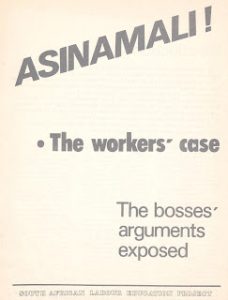
45. South African Labour Education Project (1981) ASINAMALI! The bosses’ arguments exposed. Available at https://militantarchive.blogspot.com/2017/12/asinamali-workers-case-1981.html (Accessed 24 February 2026)