Marxist
Education Portal

Education Portal
Sometimes, capitalist governments have sought to delay the onset of a recession by an expansion of credit, in effect borrowing against future income. But when it looks like the future income may not cover the debts soon enough, or ever, eventually bubbles burst. The increased use of debt to maintain the functioning of the capitalist economy - and the repackaging of debt through complex financial instruments - is a sure sign of an economy locked in crisis.
In today’s unstable world, global debt has reached levels unprecedented in capitalism’s history. In 2022, it was estimated that the combined debts of corporations, states and individuals were equal to more than three-and-a-half times global GDP. [i.e. the total annual global income]. In 2025, notable capitalist economies – such as those of the US, France, Britain and Italy - all had debt-to-GDP ratios of more than 100%. Debt repayments are having disastrous consequences in much of the neo-colonial world. Twenty of the poorest countries spend more than 20% of government revenue on paying interest on the debt.
Capitalist banking and finance institutions are meant to help capitalism develop by lending for investment. If companies do not have enough capital to start or expand production, they can borrow, then pay it back with interest as surplus value starts to be created. Finance is meant to ‘oil the wheels of industry’.
A company needing cash for investment could also issue more shares, on a promise of paying shareholders a regular dividend from profits. The shares are issued at a certain price. In as much as this enables companies to employ workers to create new value, it can play a positive role for those firms.
Shares of corporations that trade their shares publicly are sold and resold on the stock markets. The price goes up and down based on demand, and forecasts on the company’s future. However, while increases in share prices increase the nominal value of a company on paper, they often have no relation to the real value of the company – the capital actually existing and the size and skills of the workforce, becoming in part what Marx called ‘fictitious capital’. There are many variations of this.
Today, that aspect of the world economy is like a giant casino, with the speculation on shares, currencies, etc, playing no productive role. Once again, a range of asset ‘bubbles’ have been allowed to grow, exacerbated by financial speculation. The impact the financial world can have on the real economy was shown in the banking collapse of 2007, which began with the collapse of the ‘sub-prime’ mortgage market in the US.
Mortgages had been incorporated into ‘financial instruments’ which mixed good debt with bad debt that would never be repaid. Those second-hand debts were then bought and sold as speculation, but eventually confidence in their future potential to be resold plummeted. That had an immediate worldwide impact on banks that had bought them in vast amounts. Some banks collapsed, others only surviving because of huge government bailouts. Despite those bailouts and other government measures, a huge recession was still triggered by the financial crisis.
This increasingly parasitic behaviour arises from the lack of profitable markets available for the capitalists to generate surplus value through commodity production. With profit rates squeezed, a significant section of the capitalist class instead makes it living from finance capital – getting rich from privatisation, from gambling on the money markets, from interest on debt.
The staggering levels of global debt, combined with financial speculation, are paving the way for a new financial and systemic crisis, perhaps even deeper than the ‘Great Recession’ of 2008.
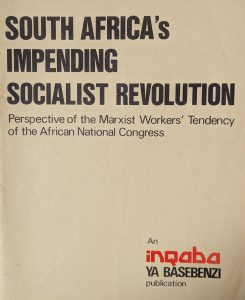
54. Inqaba ya basebenzi (1982) South Africa’s Impending Socialist Revolution. Available as an audiobook at: https://www.socialistparty.org.uk/audio/SP%20Books/South%20Africa's%20Impending%20Socialist%20Revolution%201981/ (Accessed 24 February 2026)
55. Philip Stott, Socialist Party Scotland CWI (2025) Fractured world economy, AI asset bubble - heading for a crash? Available at https://www.socialistworld.net/2025/11/03/fractured-world-economy-ai-asset-bubble-heading-for-a-crash/ (Accessed 24 February 2026)