Marxist
Education Portal

Education Portal
The next concepts to discuss are, firstly, money and prices, followed by a discussion on the causes of inflation, when there is a general and continuing rise in prices. However, Marxist economics presents a very different analysis from that put forward by capitalist economists.
Money and prices
In early human societies exchange was by barter – ‘I will give you my pig in return for so many sacks of wool’. Today’s much easier method is, of course, to use money as a token of exchange. The money value of each commodity is its price.
At first it was necessary for that money to have its own inherent value, to give people confidence in its worth. So, precious metals came to be used – particularly silver or gold – with their own value put into the form of bars and coins. Their value arose from the labour time used to mine and refine them.
People were therefore confident that when selling a commodity with a certain value based on the labour time used to create it, they could get money in return with the same value, and which they could then use to exchange for something else that they needed.
Over time, the commodity that became universally used was gold. However, as economies grew and became more complex, paper money, and coins made from cheaper metals, were created by state banks. The inherent value of that money was much lower or negligible, a mere token or IOU. But governments ‘guaranteed’ its declared value.
English bank notes still have ‘I promise to pay the bearer on demand the sum of… pounds’ printed on them and signed by the Bank of England’s chief cashier. Originally this was intended to give people confidence that they could get the note’s equivalent in gold from the bank if they wished. However, the ‘gold standard’ - tying the value of national currencies to that of gold - no longer applies. The Bank of England, like other central banks, still holds substantial gold reserves but nowhere near enough to be able to replace with actual gold all the sterling held by people worldwide in all its forms – in banks, other finance institutions and physical currency.
The price of a commodity is ultimately determined by its value. A commodity that requires a large amount of socially necessary labour time – such as a car – would not be priced at the same level as something requiring far less labour, such as a chair.
But prices do fluctuate up and down either side of that level of value, particularly according to ‘supply and demand’. However, the capitalist market means that if a shortage was generating a high price for a specific commodity well above its actual value, that would encourage other companies to start producing those commodities in the hope of profit. That would increase their supply and tend to reduce their price back down towards the level of their value.
In addition, there would always be a limit on how much most people would pay for, say, a chair if they were in prolonged short supply. They would find something else to sit on instead! On the other hand, in the case of excessive supply on the other hand, there would be a limit as to how low a price that a manufacturer would be prepared to sell their products for, while still being able to continue producing. These pressures mitigate against prices ranging too far from the commodity’s actual value, based on the necessary labour time used to create them.
Inflation
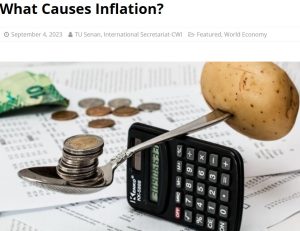
Capitalist economies often experience inflation – a general and continuing rise in prices. Capitalists are generally happy with a certain low level of inflation, as it encourages people to spend rather than see the value of their savings eroded. Inflation also helps to erode real wages and reduces historic debt – in both cases it makes the cost of, say the $500 you owe them, less in real terms. However, when it gets too high, it can cause great instability in the system, with rising costs pushing a layer of companies into bankruptcy and a sharpening of the class struggle as workers are forced to take strike action to defend their deteriorating living standards.
The bosses often try to blame workers, by claiming that wage rises cause inflation. But it is socially necessary labour time that determines value, and value determines the level around which the price of commodities fluctuates. There is no direct causal relationship between wage rises and price rises.
Global management consultancy firm McKinsey summed up the real situation when in 2019 it wrote: “Labour’s share of national income – that is, the amount of GDP paid out in wages, salaries, and benefits – has been declining in developed and, to a lesser extent, emerging economies since the 1980s”. If so, the rise of inflation across much of the globe in 2022 could not have been due to the level of workers’ wages, which had continued to erode in real terms in the years after McKinsey’s words. Neither would it be inflationary if workers succeed, through struggle, in forcing a reversal of that trend – i.e. a transfer back into workers’ hands of some of the vast wealth that their bosses have been accumulating at their expense.
In actual fact, that rise in inflation was triggered by disruptions to the supply of goods during the Covid pandemic lockdowns and other global events such as the war in Ukraine. Outright profiteering from the disruption and shortages, and also parasitic financial speculation, played a major role in exacerbating the price rises. Speculation on future prices, where nominal future amounts of a commodity are bought on the expectation of making a profit, can rapidly increase the demand and push up prices.
Another potentially inflationary factor in capitalist economies can be when governments significantly increase the money supply by printing or electronically creating more money, without there being any corresponding increase in the total wealth in the economy. Globally, huge sums were created in this way during the 2007-08 crisis and aftermath, and to an even greater extent during the Covid pandemic, another underlying factor in the 2022 inflation spike.
A look into history shows times when governments have printed money in vast amounts to cover debt, resulting in hyperinflation. One such example was the interwar German government attempting to pay off the heavy burden imposed on it by war reparations as a penalty for losing the first world war. The circulation of money in an economy is nevertheless very complex, particularly as some of it can be stashed away out of immediate use. Nevertheless, when more money is available than previously for the same amount of goods and services, inflation can be a consequence.
However, there is no single cause that, on its own, provides the cause of inflation. It arises from a number of interconnected factors, all arising from the general economic crisis of capitalism.
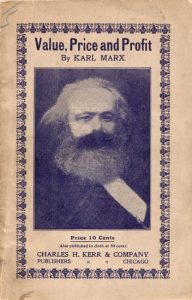
49. Karl Marx (1865) Value, Price and Profit. Available at https://www.marxists.org/archive/marx/works/1865/value-price-profit/ch01.htm#c4 (Accessed 24 February 2026)
50. TU Senan, CWI (2023) What Causes Inflation? Available at https://www.socialistworld.net/2023/09/04/what-causes-inflation/ (Accessed 24 February 2026)