Marxist
Education Portal

Education Portal
Historical materialism applies the laws of dialectical change to the development of human history. It takes the economic ‘base’ of any society – the way that it produces and exchanges things, as the key to explaining its ‘superstructure’ – its laws, culture and ideas. It also identifies the struggle between classes over who controls the wealth produced by that society as the driving force of history.
“The materialist conception of history starts from the proposition that the production of the means to support human life and, next to production, the exchange of things produced, is the basis of all social structure; that in every society that has appeared in history, the manner in which wealth is distributed and society divided into classes or orders is dependent upon what is produced, how it is produced, and how the products are exchanged. From this point of view, the final causes of all social changes and political revolutions are to be sought, not in men's brains, not in men's better insights into eternal truth and justice, but in changes in the modes of production and exchange. They are to be sought, not in the philosophy, but in the economics of each particular epoch”. (Engels, Socialism: Utopian and Scientific) 19
Capitalism, the system we live under today, is unequal and undemocratic. It is a class society, based on the exploitation of the working class by a ruling class – the capitalists, a small minority of the population who own and control the main industries and financial institutions.
In capitalist education institutions, we are led to believe that class society has always existed, that class exploitation is natural and unavoidable, and that capitalism is the best way of organising society. We are also told that history is made only by famous individuals and that working-class people have no power to change the system of society. A Marxist analysis of history reveals that none of this is true.
The theory of ‘historical materialism’, developed by Karl Marx and Friedrich Engels, provides a framework for socialists to analyse human society and the laws of its development. It explains that class societies have not always existed; that in fact the earliest human societies were classless societies based on cooperation and consensus, without systematic exploitation or oppression.
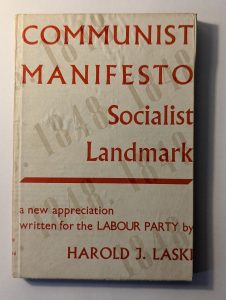
It also explains that, as the capitalist class brought workers together in the workplace; to exploit them for their own profits of course, it created another class with the potential power to overthrow them – the working class. In the famous words of Marx and Engels in the ‘Communist Manifesto’, the capitalists have unwittingly created “its own gravediggers”. 20
Economic determinism
Before going on in the next lessons, which summarise the materialist analysis of the different phases of human history, it’s worth raising an important warning for anyone who really wants to understand Marxism – be careful not to lapse into an undialectical oversimplification of historical materialism.
Marxism is not a dogma, and we reject the concept of ‘economic determinism’ – the idea that the course of history neatly unfolds simply through variations in the economic cycle. On the contrary, dialectical materialism explains that an all-sided analysis of any stage of history is always required, looking concretely at all the contradictory processes at play.
The economic base is always finally decisive, but the ideologies and institutions of the ‘superstructure’, and the actions of parties and individuals, also contribute to the overall ‘parallelogram of forces’, sometimes decisively. As Lenin was fond of saying, ‘truth is concrete’ and working out in which direction the final ‘resultant force’ will be acting at any given historical juncture cannot be ascertained by simply looking at economic factors alone.
As Lenin put it in his ‘Philosophical Notebooks’,21 “‘History does nothing, it possesses no immense wealth,’ it ‘wages no battles.’ It is man, and not ‘history,’ real living man, that does all that … history is nothing but the activity of man pursuing his aims.” In other words, as the quote from Che Guevara on the front of the CWI book ‘Symbol of Struggle’, 22 puts it, “It is not for revolutionaries to sit in their doorways of their houses waiting for the corpse of imperialism to pass by”. Changing society requires human action; to overthrow capitalism, it requires action by the organised working class.
In particular, as Peter Taaffe wrote in an article on the ‘Communist Manifesto’ included in the book ‘Great Revolutionaries’ 23 : “Capitalism will not voluntarily vacate the scene of history, merely because it has exhausted all the possibilities latent within it. … Only with the conscious mobilisation of the working class, through its own independent mass party, can the huge obstacle which capitalism represents to further human progress be removed.”
19. Frederick Engels (1880) Socialism: Utopian and Scientific. Available at https://www.marxists.org/archive/marx/works/1880/soc-utop/ch03.htm (Accessed 24 February 2026).
20. Karl Marx and Frederick Engels (1848) Manifesto of the Communist Party. Available at https://www.marxists.org/archive/marx/works/1848/communist-manifesto/ch01.htm#007 (Accessed 24 February 2026).
21. Vladimir Ilyich Lenin (1895) Philosophical Notebooks (on The Holy Family by Marx and Engels). Available at https://www.marxists.org/archive/lenin/works/1895/misc/holy-fam/holy-fam.htm (Accessed 24 February 2026).
22. Tony Saunois (1997) Che Guevara: Symbol of Struggle is available from Left Books at https://leftbooks.co.uk/product/che-guevara-symbol-of-struggle/ (Accessed 24 February 2026).

23. Peter Taaffe (1998) Marxism: the Next Big Idea. Available at https://www.socialistparty.org.uk/articles/100648/25-08-2010/marxism-the-next-big-idea/ (Accessed 24 February 2026).
24. Karl Marx (1845) Theses On Feuerbach. Available at https://www.marxists.org/archive/marx/works/1845/theses/theses.htm (Accessed 24 February 2026).
25. Frederick Engels (1890) Letter to J. Bloch. Available at https://www.marxists.org/archive/marx/works/1890/letters/90_09_21b.htm (Accessed 24 February 2026).
26. Leon Trotsky (1940) The Class, the Party and the Leadership. Available at https://www.marxists.org/archive/trotsky/1940/xx/party.htm (Accessed 24 February 2026).