Marxist
Education Portal

Education Portal
The tenth lesson summarising Trotsky's ‘History of the Russian Revolution’ looks at how reaction attempted to organise against the revolutionary masses in the weeks after the February Revolution.
Again, it draws largely on the content of Chapter 10 of Trotsky’s ‘History’, entitled ‘The New Power’.
Reaction cannot rule as it wishes
Reaction began to organise around the banner of the Kadet Party, now the only openly organised non-socialist party, and all its tendencies hastened to group themselves around the Provisional Government.
On March 2nd the Council of Trade and Industry, representing the capitalists, declared its support for the new government and was soon followed by the town dumas and the provincial councils or ‘zemstvos’. On March 10th even the Council of the United Nobility, previously the mainstay of the Tsar, declared its support for the Provisional Government.
The possessing classes began, first cautiously and then more and more boldly, to campaign for a 'single sovereignty', blaming all disorders and difficulties upon the existence of the Soviet. Nevertheless, the reaction and, in particular, the Provisional Government, did not know how much of their real intentions they could risk revealing before the masses. The Soviet leaders in the 'Contact Commission' were not much help either because they too found it hard to judge the exact level of dissatisfaction.
However, there was no serious force behind these veiled threats from the propertied classes. Property, as Trotsky puts it, “represents an enormous power so long as it is universally recognised and supported by that system of compulsion called Law and the State. But the very essence of the present situation was that the old state had suddenly collapsed, and the entire old system of rights had been called in question by the masses.” [Chapter Ten of the ‘History of the Russian Revolution’ 18 ]
The new ministers took over the old Tsarist apparatus but found that its rule was no longer obeyed. The provincial commissars, often just the old feudal landlords that used to be presidents of the zemstvos given new titles, faced the same problem. They took possession of the clerks, typewriters and chiefs of police only to find that real power lay with the soviets. This was even more true in the provinces where the local Menshevik and Social-Revolutionary leaders hadn’t always grasped the requirement to renounce the power as quickly as their colleagues in Petrograd!
In the factories the workers were regarding themselves more and more as the proprietors. In the country the peasants began to look with an ever more determined eye at the landlords' land. “The property-holders, deprived of the possibility of using their property, or protecting it, ceased to be real property-holders and became badly frightened Philistines who could not give any support to the government for the simple reason that they needed support themselves. They soon began to curse the government for its weakness, but they were only cursing their own fate.” [Chapter Ten 18 ]
In truth, the Provisional Government's only real support came from the Compromise leaders - and without it the government could not survive.
The bourgeois continued to try and carry out its adopted policy - to make as few reforms as possible. As early as March 1st, the government had issued an order for the arrest of all police officials, but this was, if anything, merely a means of ensuring that these hated men were given refuge from the masses in the jails. Similarly, the Decree of Amnesty on March 8th was a belated gesture since, by then, prisons had been opened by the people all over Russia.
Kerensky, in a moment of revolutionary zeal, actually carried out a resolution of the Soviet E.C., introducing representatives of the workers and soldiers as members of the courts of justice. However, the 'socialist' lawyer Demianov decided that the measure would not be carried out, since "the policies of a revolutionary government ought never to offend anybody unnecessarily”! As Trotsky comments: “That was, at bottom, the guiding principle of the whole Provisional Government, which feared most of all to offend anybody from the circles of the possessing classes, or even the tsarist bureaucracy. To be sure the masses might be offended. But that was the Soviet's business; the masses did not enter into the field of vision of the government" [Chapter Ten 18 ]
Order No.1
About the only worthwhile measure to be produced in those days was the famous ‘Order No.1’, a charter for the freedom of the revolutionary army. It had been passed by the Soviet in the heady days of revolution at the dictation of the mutinous soldiers. It declared, amongst other things, "that elective committees shall be formed in all military regiments; soldiers' deputies shall be elected to the Soviet; in all political acts the soldiers shall submit to the Soviet and its committees; weapons shall be in the control of the regimental and battalion committees, and shall 'in no case be given up to the officer'; on duty, the severest military discipline - off duty, complete citizens’ rights." [Chapter Fourteen of the ‘History of the Russian Revolution’ 21 ]
The Soviet E.C. had not dared oppose the soldiers' demands at the meeting but tried afterwards to send out the order together with an appeal that effectively demanded the soldiers' subordination to the old commanding staff. The typesetters simply refused to set up the document! The E.C. then tried to limit the order to the Petrograd military district only - but in vain, the revolutionary soldiers would not let their new-found rights be taken away.
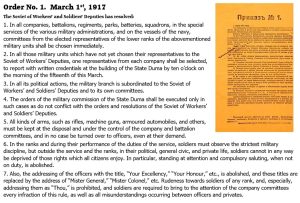 The content of "Order No. 1"
Apart from this Order No.1, everything continued pretty much as before, despite the masses' protests. The 'Holy Synod' continued to sit; Greek Orthodoxy remained the state religion; the Tsar's old State Council continued to draw their salaries; the arrested ministers were even voted a pension! Against all the teachings of Marxism on the State, the Mensheviks were allowing the old bureaucracy, the old judges, the old army commanders to remain in place so as not to offend anybody! The only initiative was shown in the haste to remove the old Tsarist limitations on holding stocks and shares and setting up joint stock companies!
The workers demanded an eight-hour day - the Provisional Government said nothing, leaving the Soviet leaders to try and pacify its ranks. The peasants demanded land - the government said that any reforms would be best left for the Constituent Assembly to decide on. But they knew full well that they had no intention of ever calling such an assembly if they could avoid it.
Only on March 25th did the government finally agree to call a Special Conference for the working out of an election law for the assembly. Needless to say, the conference never opened. However, Shingarev "ordered the formation of local land committees - prudently refraining, however, from defining their tasks and functions. The peasants had an idea that these committees ought to give them the land. The landlords thought the committees ought to protect their property. From the very start the muzhik's [nickname for peasant's] noose, more ruthless than all others, was tightening round the neck of the February regime" [Chapter Ten 18 ]
18. Leon Trotsky (1930) The History of the Russian Revolution: Chapter Ten is available at https://www.marxists.org/archive/trotsky/1930/hrr/ch10.htm (Accessed 6 March 2026).
21. Leon Trotsky (1930) The History of the Russian Revolution: Chapter Fourteen is available at https://www.marxists.org/archive/trotsky/1930/hrr/ch14.htm (Accessed 6 March 2026).
A video summarising this tenth lesson: 'Video Ten - Reaction tries to Organise' can be found here: https://youtu.be/WA4eu14mJf0