Marxist
Education Portal

Education Portal
This lesson explains how, even though the working class, with the support of the soldiers, had led the February Revolution, they were elbowed aside by middle-class supposedly "socialist" leaders who sought to hand power back to the capitalist bourgeoisie.
It is based on the events set out in Chapters Six to Nine of Trotsky’s ‘History’.
The fall of Tsarism
On the evening of February 27th, Rodzianko, the President of the Duma, had sent the Tsar a new telegram ending with the words: "The last hour has come when the fate of the fatherland and the dynasty is being decided". The Tsar is recorded as responding: "Again that fat-bellied Rodzianko has written me a lot of nonsense". [Chapter Six 14 ]. It wasn't nonsense, although from outside Petrograd it was scarcely possible to believe that the news coming from the revolutionary capital could be true.
General Ivanov, who had successfully crushed the revolutionary sailors of Kronstadt in 1905, was ordered to march troops from the front to Petrograd to put down the rebellion. The ruling class still thought that they had plenty of time in which to act. Meanwhile, General Khabalov was trying to carry out an order to declare martial law in the capital - but not only did he have no forces to rely on, he couldn't even find paste and brushes to stick up the declaration!
During the 27th, the gaols had been seized, and political prisoners freed. The Bolsheviks, including the Petrograd leaders arrested in the early hours of the 26th, had gone straight to the workers’ districts. They sought to meet up with the workers and soldiers to ensure that the revolution was carried through to the end.
The Mensheviks, like the members of the Military-Industrial committees arrested at the same time, had taken a different line of march. They had set out for the Tauride Palace, home of the Duma, where some of the radical intelligentsia and a few revolutionary officers had been trying to set up a kind of revolutionary headquarters. On the evening of the 27th, a stream of workers, soldiers and assorted radicals came to the Palace looking for some kind of leadership. From there detachments of soldiers were sent out to guard key points like the railway stations, and arrested generals, ministers, policemen and so on who were brought to the Palace to be imprisoned.
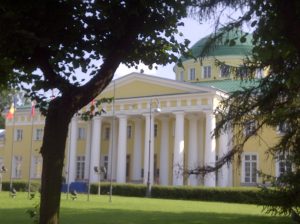 The Tauride Palace in 2012 - M Powell-Davies
However, the workers' districts did not need orders from the Tauride Palace and many distrusted these 'leaders' that had suddenly appeared from nowhere. Indeed, the worker-Bolsheviks and the best workers of the other left parties remained at the sharp end, directing the mopping-up operations of the 28th, making arrests and spreading the mutiny to new regiments in the capital and in surrounding areas.
On the 28th Ivanov telegraphed to Khabalov to find out the latest news. Khabalov's reply, set out by Trotsky in his ‘History’ [Chapter Six 14 ] tells its own story:
“Q. How many troops are in order and how many misbehaving? A. I have at my disposal ... four companies of the Guard, five squadrons of cavalry and Cossacks, and two batteries; the rest of the troops have gone over to the revolutionists, or by agreement with them are remaining neutral. Soldiers are wandering through the town singly or in bands disarming officers.
As Trotsky adds, “Having received this unequivocal illumination as to the real situation, Ivanov called off his mission to save the Tsar! Khabalov himself was arrested soon after”.
The Tsar had finally begun to suspect that Rodzianko had not been speaking nonsense. He decided to return in his train to Petrograd to rejoin his family. The railway workers had other ideas. They wouldn't let him pass. While his train wandered from place to place trying to find a way through, the Tsarina was sending telegram after telegram to him. All were returned with the message: ‘Whereabouts of the addressee unknown’!
Finally, on the night of March 1st, the Tsar agreed to send a message to Rodzianko saying he was prepared to do a deal with the ‘Progressive Bloc’. But, Trotsky notes, “the Tsar's clock was way behind. Rodzianko replied ‘Your proposal is not enough; it is now a question of the dynasty itself. The anarchy has reached such proportions that I (Rodzianko) was this night compelled to appoint a Provisional Government’.” [Chapter Six 14 ]
The new Soviet and its E.C.
While the proletariat and revolutionary soldiers had continued the real business of revolution, the petty-bourgeois radicals, true to form, had busied themselves with getting hold of positions of leadership.
The freed Mensheviks, together with the Menshevik Duma deputies like Cheidze and Skobelev and other right-wingers like the Trade Union leaders, straight away set about forming a ‘Provisional Executive Committee of the Soviet of Workers' Deputies’ – or the ‘E.C.’ for short. It soon filled out with various well-known socialists, including some Bolsheviks, and summoned the workers to elect deputies immediately.
The tradition of soviets, which had taken root in the movement thanks to the experience of 1905, together with the presence of old recognised leaders, meant that this E.C. immediately became the focus of all hopes and also all authority for the mass of workers and soldiers. However, unlike the Soviet of 1905, its representatives were, on the whole, elements who had played little or no role in the revolution. Their views and experiences did not coincide with those of the activists who had actually led the revolution in the streets. However, those revolutionaries had no organisation or well-known leaders with which to stamp their authority on events.
Even in the cauldron of Petrograd, the consciousness of those fresh to the struggle lagged behind events. They had not had time to free themselves fully from old opinions and prejudices during the rapid changes of the war years, let alone in the five days of revolution. During the insurrection the broad masses had followed the lead of the most revolutionary elements without being actively involved in the struggle themselves. Now, the middle-class officials, lawyers and other radicals elbowed the workers and soldiers to one side, leaning upon the illusions and inexperience of these fresher masses to build their personal positions.
The first session of the Soviet had taken place in the Tauride Palace on the evening of the 27th, and, with some additions, ratified the E.C. membership. In the midst of proud and joyful speeches from soldiers' deputies, it was agreed to build on the fraternisation of the days of revolution by uniting the garrison with the workers in a general ‘Soviet of Workers' and Soldiers' Deputies’.
This inclusion of the representatives of the overwhelmingly peasant army gave the soviets a much wider base of support than in 1905. From the beginning, the E.C., in the name of the Soviet, acted as the nation's sovereign power. It organised a revolutionary staff and controlled the garrison, food supplies and the State Bank and Printing Office, which it occupied with a revolutionary guard.
Trotsky explains how, from the outset, real power was in the hands of the soviet, rather than with the newly appointed ‘Provisional Government’: “The Octobrist deputy Shidlovsky, one of the leaders of the Progressive Bloc, relates how, ‘The Soviet seized all the Post and Telegraph bureaux, the wireless, all the Petrograd railroad stations, all the printing establishments, so that without its permission it was impossible to send a telegram, to leave Petrograd, or to print an appeal.’ In this unequivocal characterisation of the correlation of forces, it is necessary to introduce one slight correction: the ‘seizure’ of the Soviet of the telegraph, railroad stations, printing establishments, etc., meant merely that the workers and clerks in those enterprises refused to submit to anybody but the Soviet”. [Chapter Nine 16 ]
However, even in these first days of the victory, those socialists at the head of the Soviet were looking around for those that they felt should really have the power - the bourgeoisie. As Trotsky had suggested, the leaders of the Soviet E.C. showed their petty-bourgeois inadequacy before the big bourgeoisie. Hiding their cowardice with theoretical arguments about the need to limit the struggle to a ‘bourgeois’ revolution (see Lesson Three), they looked to the bourgeois leaders in the Duma to take the power from them and form a ‘Provisional Government’.
Bewildered by exaggerated reports that the masses were marching on the Duma, the bourgeois deputies in panic had hurriedly suggested forming a ‘Provisional Committee’. It was this Provisional Committee of the Duma that the Soviet E.C. appealed to, demanding that they take power in their hands. However, the Duma leaders tried to stall, fearful of their positions in case the insurrection might turn out, as they still hoped, to be defeated.
In the end, on the 28th, realising that it might be the only way of tearing the revolution away from more threatening leadership, they decided to agree to the Soviet E.C.'s demands. As Trotsky says, their moral was clear: "If the monarchy wins, we are with it, if the revolution wins, we will try to plunder it". [Chapter Nine 16 ]
Trotsky relates how the reformist socialist Sukhanov perfectly expressed the joy of the fearful middle-class at the news - "I felt that the ship of revolution, tossed in the squall of those hours by the complete caprice of the elements, had put up a sail, acquired stability ... amid the terrible storm." On the contrary, as Trotsky adds: "What a high-flying formula for a prosaic recognition of the slavish dependence of the petty bourgeois democracy upon capitalistic liberalism! And what a deadly mistake in political perspective. The handing over of power to the liberals not only will not give stability to the ship of state, but, on the contrary, will become from that moment a source of headlessness of the revolution, enormous chaos, embitterment of the masses, collapse of the front, and in the future, extreme bitterness of the civil war" [Chapter Nine 16].
14. Leon Trotsky (1930) The History of the Russian Revolution: Chapter Six is available at https://www.marxists.org/archive/trotsky/1930/hrr/ch06.htm (Accessed 6 March 2026).
16. Leon Trotsky (1930) The History of the Russian Revolution: Chapter Nine is available at https://www.marxists.org/archive/trotsky/1930/hrr/ch09.htm (Accessed 6 March 2026).
A video summarising this seventh lesson: 'Video Seven - The Capitalists and the Monarchy' can be found here: https://youtu.be/8j5pB5hVrdE