Marxist
Education Portal

Education Portal
This fourth lesson focuses on the rhythm of the Russian workers’ struggle from the defeat of the 1905 revolution to the outbreak of world war in 1914, and then discusses the effect of the war itself.
It is based chiefly on Chapters Two and Three of Trotsky’s ‘History’.
Recovering from defeat
After the defeat of the 1905 revolution, the combination of an industrial recession and the repression of the victorious counter-revolution drove the defeated Russian workers’ movement backwards.
By 1910 the number of strikes had fallen back almost to nothing. It was in these years of reaction, where prejudice and scepticism again took hold of the discouraged masses, that the ideas of Menshevism took final shape, leading to the decisive break with the Bolsheviks in 1912.
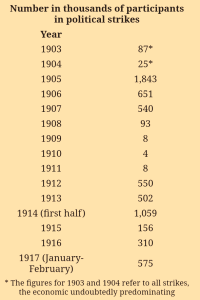
However, the industrial boom that began in 1910 gave the workers new confidence that they could risk taking action. A wave of political strikes against the government broke out in 1912. By the beginning of 1914, over 1 million workers were taking action according to records of the factory inspectors, about 50% of the entire workforce. The new upswing was not simply a repeat of the 1905 movement but reopened on a higher level, enriched by past experience, and Bolshevism began to rise swiftly on the new revolutionary tide.
The authorities were well-informed about the Bolshevik organisation thanks to secret service infiltrators that had managed, for example, to fill 3 of the 7 places on the Petrograd Bolshevik Committee by 1914! The secret police department reports warned that “the most energetic and audacious element, ready for tireless struggle, for resistance and continual organisation, is that element, those organisations, and those people who are concentrated around Lenin” [Chapter Three of the ‘History of the Russian Revolution’ 5 (1930)]
The agrarian struggle in the villages followed a similar pattern of downturn and then revival although diverted into a struggle between rich and poor peasants in the new co-operatives, even reaching the level of armed conflicts over the division of communal land. The big landlords, however, did not totally escape the peasants' anger and land seizures and the burning of harvests and haystacks became more frequent.
By 1914, a revolutionary situation was clearly approaching. But the strike figures also show how the beginning of the World War cut right across developments. It knocked the movement right backwards, but only to powerfully accelerate the march of events later as the war wore on.
The effect of the outbreak of world war
The immediate effect on the workers' movement was devastating. Severe penalties were imposed for striking. The workers’ press was closed down. Trade unions and political organisations were brutally repressed. The Bolsheviks, alone amongst the socialist parties, began after initial hesitation to try and spread anti-war agitation but faced enormous difficulties. In November 1914, the five Bolshevik ‘Duma’ assembly deputies were arrested, including Lev Kamenev, and sent into exile in Siberia.
These severe sentences provoked hardly a murmur of protest amongst the workers. They were disorientated by the war and the appeals for yet more 'patriotic' production in the factories, not to mention the retreat of nearly all the leaders of the European socialist parties into the camps of their respective national governments in support of the slaughter, leading to the collapse of the Socialist ‘Second International’. Lenin was so shocked when he saw the issue of Vorwärts, the newspaper of the German Social Democrats (SPD) containing the news that the SPD deputies had voted to support the Kaiser’s war budget, that he thought at first it was a fake! Trotsky recalls on the other hand, that his more direct experience with the SPD leaders meant that it was, sadly, of little surprise to him.
In 1915, a handful of socialists who were prepared to speak out against war met in Zimmerwald, Switzerland. They included Lenin and Zinoviev for the Bolsheviks, Martov and Axelrod for the Mensheviks, Chernov from the SRs and Trotsky himself. In his autobiography, ‘My Life’, Trotsky recounts that: “The delegates, filling four stagecoaches, set off for the mountains. The delegates themselves joked about the fact that half a century after the founding of the first International, it was still possible to seat all the internationalists in four coaches. But they were not sceptical. The thread of history often breaks then a new knot must be tied. And that is what we were doing in Zimmerwald. The days of the conference, September 5 to 8, were stormy ones. The revolutionary wing, led by Lenin, and the pacifist wing, which comprised the majority of the delegates, agreed with difficulty on a common manifesto of which I had prepared the draft. The manifesto was far from saying all that it should have said, but, even so, it was a long step forward. Lenin was on the extreme left at the conference. In many questions he was in a minority of one ... In Zimmerwald, Lenin was tightening up the spring of the future international action. In a Swiss mountain village, he was laying the cornerstone of the revolutionary International”. [Trotsky, My Life 9 (1930) ]
Revival
The more revolutionary workers had soon been sent to fight at 'the front' and their places had been taken by politically backward elements from the villages. In Petrograd, there was about a 40% change in the workforce. The Bolsheviks were left without any central organisation, its leaders under arrest or in exile. However, rising discontent still began to come to the surface, if at first in contradictory ways, for example in criticisms that the war was being badly run at the top.
In 1915, while the factory workers held back, fearing being sent to the trenches, the less organised sections, such as working class women, first felt bold enough to protest. Food disorders, sometimes riots, broke out over shortages, soon spreading over the whole country. These early battles broke through the lull and sparked strikes from the organised workers.
Prices had risen far beyond wages and the first workers’ strikes, in June 1915, centred on the textile workers, were economic. The protests were stormy after the preceding lull, accompanied with meetings and battles with the police and army, in which several workers died. The movement was very raw compared to that of 1912-14, unsurprising given the weakness of the workers' organisations and the involvement of new raw layers.
The Tsar's ministers responded with even greater repression. The big bourgeoisie on the other hand attempted to split the movement by involving elected workers’ representatives on the boards of “Military-Industrial Committees” running the factories. Using these leaders, often Mensheviks, the bosses hoped to impose a regime of ‘industrial patriotism’ to hold back the working-class. Despite these moves, the weakened Bolshevik organisation began to revive through the impetus of the strike movement, and began to find their slogans - against the war and the government, and for a republic - getting a more sympathetic response.
The strike wave deepened and on the traditional protest-day of January 9th 1916, the eleventh anniversary of the "Bloody Sunday" massacre of workers in 1905, a widespread strike took place - whereas almost nothing had occurred in 1915. Troops and workers were now often making friendly contacts on demonstrations.
The war had caused chaos in the villages. About 10 million rural workers and 2 million horses had been taken to the front. The weaker homesteads began to find it impossible to survive and by 1916 the middle layer of peasants were also going under. The mood of opposition grew, perhaps rarely taking the form of open protests as in the cities, but then most of the young active forces of the country had been sent to fight. Nevertheless, the soldiers did not forget the injustice of life in the villages as they crouched in the trenches.
As a further example of its combined development, Russia had at its disposal the latest weapons of war, secured from its allies, but neither the capacity to reproduce them in its factories nor transport them to the front with sufficient speed. The Russian armies proved totally incapable of competing with the strong German war machine. Its only limited successes came against the even more decrepit regime of Austria-Hungary. Out of these battles emerged some of the more confident generals that were later to lead the white armies' against the Soviet forces in the civil war following the October revolution.
Universal military service simply reproduced the contradictions and crises of the nation into the army itself. The useless commanders mirrored the rotten Russian ruling class while the peasant soldiers’ lack of technical experience meant that they could not master modern military technique. Of the first 15 million men mobilised in the first year or so of the war, 5½ million were killed, wounded or captured. In all, 2½ million were killed in the war, 40% of the total losses of the "Allies".
Soon the peasant army began to disintegrate, and, despite floggings and other brutal punishments, desertions grew. The sick and deserted brought their longing for peace back to the cities and villages. The revolutionary elements in the army finally began to get a hearing.
The economic mess grew worse. The Tsarist state demanded more and more of the national wealth to pay for the war effort. The war industries grew enormously using up all available resources and drowning peace-time branches of production. Enormous fortunes were built out of the bloody mess. The lack of fuel and bread in the capital didn't prevent the court jeweller Faberge from doing record business.
Nothing came of efforts to plan production, since the Tsarist bureaucracy and the bourgeois ‘Military-Industrial Committees’ were fighting each other for control of industry. Much of the skilled workforce had been sent to the front, the mines and factories of Poland were lost, the overloaded transport system threatened to grind to a halt.
The so-called liberal bourgeoisie, far from being a friend of the poor soldiers, were quite happy getting rich from the slaughter. They even tried to use the military defeats to help tighten their grip on economic power at the expense of the nobility, who they began to loudly accuse of being linked by family ties to the German enemy.
The workers’ thoughts began turned from the economic plane to the political plane - belief that 'if only we all strike at once we can finish the whole thing'. While in 1915 2½ times fewer workers participated in political strikes than in economic ones, in 1916 it was only twice as few.
By the end of 1916, inflation was rocketing and was now combined with an actual lack of goods to be bought. A wave of meetings and demonstrations ran through the factories uniting all of the masses' grievances - food supplies, the high cost of living, war, government - into one struggle.
By the first months of 1917, political strikes involved six times as many workers as economic strikes. Petrograd, as usual, took the leading role. The tide of opposition was growing ever higher. Bolshevik leaflets were being distributed, the general strike slogan gaining support.
Cases of fraternisation between certain factories and soldiers were observed by the secret police. The Director of Police noted that, in comparison to 1905: "The mood of opposition has gone very far - far beyond anything to be seen in the broad masses during the above-mentioned period of disturbances" [Chapter Three 5 ]. One group of police officials warned the Tsar that the revolutionary parties could now “count on the sympathy of an overwhelming majority of the peasantry, which will follow the proletariat the very moment the revolutionary leaders point a finger to other people's land", and, with some justification, noted that "the danger and strength of these parties lies in the fact that they have an idea, they have money (!), they have a crowd ready and well organised" [Chapter Two 10 ].
The provinces followed the same stages as Petrograd, if a little more slowly, but by 1917, as the strike movement swung decisively from the economic to the political plane, the role of the capital and the most advanced layers like the metalworkers became increasingly important. The 'Bloody Sunday' anniversary on January 9th 1917 was met with a strike of 150,000 in Petrograd alone. Trotsky’s figures show that over half a million workers were reported as being involved in political strikes in just the first two months of that revolutionary year, the lion's share of them in the capital. In every factory a nucleus of activists was forming, usually around the Bolsheviks. The workers now felt that retreat was impossible.
READ and DISCUSS:
1) Look at these figures for ‘political strikes’ provided by Trotsky from the reports of the factory inspectors – what do they show about the ebb and flow of struggle – and what events underly those changing moods?
2) Reading the text above and these extracts from Trotsky’s writings, why might the initial outbreak of a war be difficult for revolutionaries? Why did the betrayal by the Second International make things especially difficult?
“Like revolution, war forces life, from top to bottom, away from the beaten track. But revolution directs its blows against the established power. War, on the contrary, at first strengthens the state power which, in the chaos engendered by war, appears to be the only firm support and then undermines it. Hopes of strong social and national movements are utterly groundless at the outset of a war. In September, 1914, I wrote to Russia: “The mobilisation and declaration of war have veritably swept off the face of the earth all the national and social contradictions in the country. But this is only a political delay, a sort of political moratorium. The notes have been extended to a new date, but they will have to be paid.” [Trotsky, My Life 9 (1930) ]
“There is nothing particularly unexpected or discouraging in the fact that the working-class parties did not oppose military mobilization with their own revolutionary mobilisation. Had the Socialists limited themselves to expressing condemnation of the present War, had they declined all responsibility for it and refused the vote of confidence in their governments as well as the vote for the war credits, they would have done their duty at the time. They would have taken up a position of waiting, the oppositional character of which would have been perfectly clear to the government as well as to the people. Further action would have been determined by the march of events and by those changes which the events of a war must produce on the people’s consciousness. The ties binding the International together would have been preserved, the banner of Socialism would have been unstained … But if this did not happen, if the signal for war mobilisation was also the signal for the fall of the International, if the national labour parties fell in line with their governments and the armies without a single protest, then there must be deep causes for it common to the entire International. … It is nothing less than the complete failure of the International in the most responsible historical epoch, for which all the previous achievements of Socialism can be considered merely as a preparation”. [Trotsky, The War and the International 11 (1914) ]
3) Reading the text above and these extracts from Chapter 2 of Trotsky’s ‘History of the Russian Revolution’ 10 (1930), how might the experience of war start to change the outlook of the peasant soldier?
“The lower ranks … measured the confusion of the generals by the number of purposeless manoeuvres on soleless shoes, the number of dinners not eaten. From the bloody mash of people and things emerged a generalised word: “the mess,” which in the soldiers’ jargon was replaced by a still juicier term”.
“‘Everything for the war!’ said the ministers, deputies, generals, journalists. ‘Yes,’ the soldier began to think in the trenches, ‘they are all ready to fight to the last drop ... of my blood.’”
5. Leon Trotsky (1930) The History of the Russian Revolution: Chapter Three is available at https://www.marxists.org/archive/trotsky/1930/hrr/ch03.htm (Accessed 5 March 2026).
9. Leon Trotsky (1930) My Life is available at: https://www.marxists.org/archive/trotsky/1930/mylife/ch18.htm (Accessed 5 March 2026).
10. Leon Trotsky (1930) The History of the Russian Revolution: Chapter Two is available at https://www.marxists.org/archive/trotsky/1930/hrr/ch02.htm (Accessed 5 March 2026).
11. Leon Trotsky (1914) The War and the International is available at https://www.marxists.org/archive/trotsky/1914/war/part2.htm#ch07 (Accessed 5 March 2026).
A video summarising this third lesson: 'Video Four - The Rhythm of the Struggle - 1905 to 1917' can be found here: https://youtu.be/0y7XSjHrWKg