Marxist
Education Portal

Education Portal
This final lesson in this first of two courses summarising Trotsky’s ‘History of the Russian Revolution’, concludes with the June Soviet Congress and examines the clear signs of rising support for the Bolsheviks, not least by the banners and slogans on display at the mass demonstration - called by the 'Compromise' Soviet leaders - on June 18th in Petrograd / St Petersburg.
It is based on Chapter 22 of Trotsky's 'History of the Russian Revolution' - the final chapter of its ‘Volume One’ – and the Appendix III to that volume.
The June Soviet Congress
Although the tide of revolution was rising, the revolutionary organisations still lagged behind the pace of change. The soviets lagged behind the factory committees who, in turn, lagged behind the workers. Even the Bolsheviks lagged behind, especially in the provinces where many Bolshevik groups did not separate from the Mensheviks until May or even June. The party took time to reconstruct itself after its disorientation during the war and then under the March leadership.
Nevertheless, the Bolsheviks were taking over the leadership of the active masses, winning elections in the factories and regiments. However, just as the active layers were turning to the Bolsheviks, the small townspeople were also beginning to stir into life. They, of course, first turned to the Compromisers. Thus, in the elections to the Moscow Duma in June the SRs got over 60% of the vote. However, this did not reflect any secure growth in support for the Compromisers but, rather, the last glow of a dying tendency.
This lagging behind of the leadership was clearly shown in the first All-Russian Soviet Congress, opening in Petrograd on June 3rd. As Trotsky notes: “The congress consisted for the most part of people who had registered as socialists in March but got tired of the revolution by June. Petrograd must have seemed to them a town gone mad.” [Chapter Twenty-Two of Trotsky’s ‘History of the Russian Revolution’ 41 ]
There were 820 delegates with voting rights and 268 with just speaking rights. They represented 305 soviets that organised over 20 million people, plus 50 or so soldiers’ and peasants' groups. Of the 777 delegates declaring an allegiance, 285 were S-R's, 248 Mensheviks and 105 Bolsheviks. That meant that the left-wing of the Bolsheviks and Martov’s Menshevik-lnternationalists made up less than 20% of the delegates.
Trotsky attended as a delegate of the Mezhrayontsi [‘Inter-District group’], an organisation representing about 4,000 Petrograd workers, which he had remained part of, so as to win over the group to the Bolsheviks. This eventually happened in August. Trotsky was then immediately elected to the Bolshevik C.C., being in fact one of the four candidates with the highest vote. This confirms that Trotsky had clearly been looked on as being, to all intents and purposes, a Bolshevik comrade since his return to Russia.
Despite the Compromisers’ majority, the congress proceeded cautiously, knowing that the masses were dissatisfied and that the Bolshevik support was much greater, particularly in Petrograd, than the congress suggested. The debates revealed that the revolution had made no changes in the Tsarist education system and that the congress was still unwilling to formally dissolve either the remnants of the old Tsarist State Duma or even its State Council. The Menshevik Bogdanov tried to excuse their timidity by saying that these organisations were dead anyway to which Martov answered: “Bogdanov proposes that we should declare the Duma dead but not make any attempt upon its life.”! [Chapter Twenty-Two 41 ]
The Coalition was ratified by 543 votes to 126, with 52 abstentions, after Tseretelli had again lectured the Congress about how the bourgeoisie must not be pushed away from being a friend of the people. He used the same excuse to make sure the congress voted down a decree in favour of the eight-hour day. It then also went on to sanction Kerensky's offensive!
Trotsky discusses the testimony of the intellectual Sukhanov on Tseretelli’s speech, where he remarked: “In Russia at the present moment there is not one political party which would say, 'Give us the power in our hands’”. But Sukhanov notes that Lenin – who did not like to interrupt speakers, however much he disagreed with them - in this case shouted back “There is!” .” [ Volume 1: Appendix III of Trotsky’s ‘History of the Russian Revolution’ 42 ]
Of course, Trotsky explains, Lenin was not suggesting a ‘coup’ - as Sukhanov claimed. Lenin knew that the task was still to gain the confidence of the masses. Instead, “Lenin’s reply … had only one meaning: We, the Bolsheviks, are ready to take the power even today if the workers and soldiers give us their confidence; in this we are distinguished from the Compromisers, who, possessing the confidence of the workers and soldiers, dare not take the power.” [ Volume 1: Appendix III 42 ]
The Bolsheviks respond
The Petrograd masses were demanding that the Bolsheviks mount a challenge to the congress, so the Party decided to organise a demonstration to show where the workers and soldiers of Petrograd really stood.
Trotsky recounts that there were different opinions amongst the Bolshevik ranks on what might occur - some feared that the mood could turn nasty, while others definitely hoped it might lead to a seizure of power. It was decided that a demonstration had to be called, or the impatient soldiers might simply come out armed and disorganised onto the streets themselves. However, the Bolshevik leaders made clear that, at this stage, the slogans should be aimed at putting pressure on the Soviet leaders, not at overthrowing the government. “The manifestation was to raise the banner of ‘Power to the Soviets’. The fighting slogan ran: ‘Down with the Ten Minister-Capitalists’. That was the simplest possible expression for a break-up of the coalition with the bourgeoisie.” [Chapter Twenty-Two 41 ]
The planned march to the congress on the 10th had been prepared in secret, to avoid the chance of counter-agitation from the Compromisers. When Pravda’s issue of June 9th announced the demonstration, the Soviet E.C. reacted with alarm, demanding the Bolsheviks call it off. The Bolsheviks countered that the Soviet had no right to stop a peaceful demonstration.
The Congress responded by passing a resolution forbidding all demonstrations for three days (in doing so, again having to take on the role of the sovereign power!). In addition, several hundred delegates were organised in groups of tens to go to the factories and barracks to dissuade the workers and soldiers from demonstrating. However, as Trotsky recounts, they were in for a shock! - “If the mountain was not allowed to come to the prophet, the prophet at least went to the mountain. The meeting proved instructive in the highest degree. A Menshevik correspondent paints the following picture: ... The congress had no authority in a good many of the factories and shops, and also in several regiments of the garrison. The members were frequently met in a far from friendly manner, sometimes hostilely, and quite often they were sent away with insults.’ ” [Chapter Twenty-Two 41 ]
The attempted pacifiers returned to the congress sleepless and demoralised. Nevertheless, fearing the demonstration could now turn into a disorganised half-insurrection, the Bolshevik C.C. decided to postpone their action. This was agreed to by the masses but not without protest, some factories adopting resolutions of censure against the C.C. Some even resigned from the party. This was a clear warning of the difficulties in choosing the right path when confronted with the widely differing moods amongst the broad masses.
Meanwhile the panicked congress leaders raged about a Bolshevik conspiracy, Tseretelli talking of ‘disarming’ the Bolsheviks, which of course actually meant disarming the revolutionary workers and soldiers. Trotsky comments, ''In other words, that classic moment of the revolution had arrived when the bourgeois democracy, upon the demand of the reaction, undertakes to disarm the workers who had guaranteed the revolutionary victory.” [Chapter Twenty-Two 41 ]
The meeting was stunned by Tseretelli's frenzied attack and in the end the congress leaders stepped back from the idea of disarming the workers. As Trotsky notes: “To carry out the Compromise policy through to a successful end - that is, to the establishment of a parliamentary rule of the bourgeoisie - demanded the disarming of the workers and soldiers. But Tseretelli was not only right. He was besides that powerless. Tseretelli was already without forces. He could procure them, if at all, only from the hands of the reaction. But they, in the case of a successful crushing of the Bolsheviks, would have immediately taken up the job of crushing the Compromise soviets.” [Chapter Twenty-Two 41 ]
The Congress decided however – at the suggestion of the Mensheviks - that they too could try and influence the masses with a demonstration, but one to show the strength of the ‘democracy’. But, alarmed by their experiences of visiting the factories and barracks, Trotsky reports that they now resolved to abolish the State Duma after all and to put forward slogans that might sound more attractive to the workers and soldiers: of ‘Universal Peace’, ‘Immediate Convocation of a Constituent Assembly’ and ‘Democratic Republic’.
However, as Trotsky comments, there was “Not a word either about the offensive or the coalition. Lenin asked in Pravda: ‘And what has become of ‘Complete confidence to the Provisional Government,’ gentlemen? ... Why does your tongue stick in your throat?’ This irony was accurately to the point: the Compromisers did not dare demand of the masses confidence in that government of which they themselves were members.” He adds that Tseretelli challenged the Bolshevik delegates: “Now we shall have an open and honest review of the revolutionary forces ... Now we shall see whom the majority is following, you or us.” But, Trotsky adds, “ The Bolsheviks had accepted the challenge even before it was so incautiously formulated.” [Chapter Twenty-Two 41 ]
The June Demonstration
The march, on Sunday the 18th, was planned to finish at the graves of the February martyrs, the E.C. no doubt hoping for a re-run of the patriotic demonstration at the funerals of March 23rd (see Lesson Thirteen). But the congress delegates assembled on ‘Mars Field’ had a shock awaiting them.
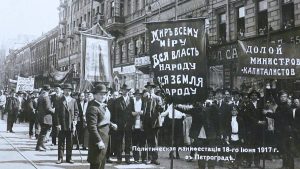 The June demonstration - The banner on the right reads "Down with the Minister Capitalists" - The Kathryn and Shelby Cullom Davis Library, No restrictions, via Wikimedia Commons
About 400,000 paraded, much less than in the funeral procession because the bourgeoisie and intelligentsia were missing. Few but the factories and barracks marched. Trotsky reports how “The first Bolshevik slogans were met half-laughingly. But these same slogans were repeated again and again. 'Down with the Ten-Minister Capitalists!’, ‘Down with the Offensive!’, ‘All Power to the Soviets!’. The ironical smiles froze, and then gradually disappeared. Bolshevik banners floated everywhere. The delegates stopped counting the uncomfortable totals. The triumph of the Bolsheviks was too obvious.” [Chapter Twenty-Two 41 ]
Trotsky adds that only three small groups carried banners supporting the Provisional Government - Plekhanov's patriotic group, a group of Jewish intellectuals, and a Cossack detachment. The first two groups wisely lowered their banners; the Cossacks had theirs torn from them and destroyed. The Vyborg section of the march flooded through under thousands of Bolshevik banners. One of the factories carried a placard with its own individual slogan: ‘The Right to Life is Higher than the Rights of Private Property’.
Trotsky remarks that the Congress delegates were forced to concede that the Bolsheviks had won in Petrograd – but that they were not in the same position of strength in the provinces or at the front. “That's all right, answered the Bolsheviks, your turn will soon come” …. “It was a great victory, and moreover it was on the arena and with the weapons chosen by the enemy. While sanctioning the offensive, recognising the coalition, and condemning the Bolsheviks, the soviet congress had called the masses on its own initiative into the streets. They came with the announcement: We don't want either offensive or coalition; we are for Bolshevism.” [ Chapter Twenty-Two 41 ]
‘A battle hovers in the air’
Trotsky points out that not all the workers and soldiers of Petrograd took part in the demonstration, and not all those who marched were Bolsheviks. However, the victory of the Bolsheviks on June 18th helped to draw the masses towards them. In many other cities similar demonstrations had also shown the growth of influence of the Bolsheviks.
The month of June finished with growing protests, calls from workers and soldiers for demonstrations, and even for the government to be thrown out. The Bolsheviks understood the mood of the active masses - who were right when they now understood that a demonstration was insufficient, that a revolution was needed. However, the leadership knew that this was still now only the mood of the most active minority, the right moment for insurrection was still far from reached.
Trotsky reports that, on June 19th, a small Kadet demonstration paraded on the Nevsky in support of the offensive. Unlike April, the two hostile camps paraded without a direct clash. That clash was, however, soon to come though, in the ‘July Days’ – to be discussed in the second part of this course.
Nevertheless, Trotsky looks ahead to those events in this ‘Volume One’ as well, returning to a point that he has made earlier: “A revolution teaches and teaches fast. In that lies its strength. Every week brings something new to the masses. Every two months creates an epoch. At the end of February, the insurrection. At the end of April, a demonstration of the armed workers and soldiers in Petrograd. At the beginning of July, a new assault, far broader in scope and under more resolute slogans. At the end of August, Kornilov's attempt at an overthrow beaten off by the masses. At the end of October, conquest of power by the Bolsheviks.” [Chapter Twenty-One 40]
Trotsky sums up the situation that had now been reached in the chain of revolutionary events of 1917: “A battle hovers in the air. The Bolshevik press explains and restrains. The patriotic press gives away its fright with an unbridled baiting of Bolsheviks. On the 25th, Lenin writes: ‘This universal wild cry of spite and rage against the Bolsheviks is the common complaint of Kadets, Social Revolutionaries and Mensheviks against their own flabbiness. They are in a majority. They are the government. They are all together in a bloc. And they see that nothing comes of it. What can they do but rage against the Bolsheviks?’ ”. [Chapter Twenty-Two 41 ]
In his short concluding chapter of ‘Volume One’, Trotsky summarises the situation as follows: “Before the proletariat came to power all the other variants of the political development were subjected to the test of life and thrown aside as worthless. The government of the liberal bourgeoisie with Kerensky as a democratic hostage, proved a total failure. The ‘April Days’ were the first candid warning addressed by the October to the February revolution. The bourgeois Provisional Government was replaced after this by a Coalition whose fruitlessness was revealed on every day of its existence. In the June demonstration ... the February revolution tried to measure strength with the October and suffered a cruel defeat. Unmistakable signs testified that all the rest of the country, although with an inevitable delay, would catch up with Petrograd. Thus, by the end of its fourth month the February revolution had already exhausted itself politically. The Compromisers had lost the confidence of the soldiers and workers. A conflict between the leading soviet parties and the soviet masses now became inevitable. After the manifestation of June 18th, which was a peaceful test of the correlation of forces of the two revolutions, the contradiction between them must inevitably take an open and violent form.” [Chapter Twenty-Three: ‘Conclusion’ to Volume One 43 ]
The tale of how those ‘open and violent’ contradictions burst open in the following month is one that will be told in our second online course analysing the remaining chapters of Trotsky’s ‘History’. For now, to finish with the words of Trotsky, “this first volume, dedicated to the February revolution, shows how and why that revolution was bound to come to nothing. The second volume will show how the October revolution triumphed”. [Conclusion’ to Volume One 43 ]
40. Leon Trotsky (1930) The History of the Russian Revolution: Chapter Twenty-One is available at https://www.marxists.org/archive/trotsky/1930/hrr/ch21.htm (Accessed 8 March 2026).
41. Leon Trotsky (1930) The History of the Russian Revolution: Chapter Twenty-Two is available at https://www.marxists.org/archive/trotsky/1930/hrr/ch22.htm (Accessed 8 March 2026).
42. Leon Trotsky (1930) The History of the Russian Revolution: Appendix III to Volume One is available at https://www.marxists.org/archive/trotsky/1930/hrr/apdx3.htm (Accessed 8 March 2026).
43. Leon Trotsky (1930) The History of the Russian Revolution: Chapter Twenty-Three (Conclusion) is available at https://www.marxists.org/archive/trotsky/1930/hrr/ch23.htm (Accessed 8 March 2026).
A video summarising both this twentieth lesson - and the preceding one as well - : 'Video Twenty - Shifts In the Masses' can be found here: https://youtu.be/c-9C2rJRzmE