Marxist
Education Portal

Education Portal
This fourteenth lesson focuses on Lenin's efforts to redirect the policy of the Bolsheviks, looking at both his 'Letters from Afar' and the 'April Theses'. It exposes the theoretical weaknesses of Stalin who, alongside Kamenev, had been increasingly blurring the differences between the Bolsheviks and the Mensheviks.
The content of this lesson is taken partly from Lenin’s writings, but also from Chapters Fifteen and Sixteen of Trotsky’s ‘History’.
The Bolshevik leaders veer towards Menshevism
“On the 3rd of April, Lenin arrived in Petrograd from abroad. Only from that moment does the Bolshevik Party begin to speak out loud, and, what is more important, with its own voice. For Bolshevism the first months of the revolution had been a period of bewilderment and vacillation.” [Chapter Fifteen of Trotsky’s ‘History of the Russian Revolution’ 24 ]
Trotsky explains that the leading organisations of the Bolshevik party had put forward no clear opposition to the Provisional Government. Indeed, at the session of the E.C. on March 1st to discuss the details of the handing over of power to the bourgeoisie, not one voice was raised against the actual giving up of power itself. This when 11 of the 39 E.C. members were Bolshevik supporters, including 3 Central Committee (C.C.) members! Similarly, at the meeting of the full Soviet to ratify the E.C.’s decision on March 2nd, only 19 out of the 400 delegates present voted against the transfer of power to the Provisional Government when there were already 40 in the Bolshevik faction.
The Bolshevik C.C. did adopt a resolution on March 4th talking of the need to move towards the ‘democratic dictatorship of the proletariat and the peasantry’, but this was really just a nod to the old formula of Lenin, rather than it being backed up with any directives for action. In reality, the leadership submitted to the position of the Soviet majority.
As Trotsky had predicted in 1909 - and as discussed in Lesson Three - now, after an initial revolutionary victory, the anti-revolutionary side of the old Bolshevik formula was being revealed. The first issue of the new Bolshevik newspaper Pravda (‘Truth’) on March 5th declared, ‘The fundamental problem is to establish a democratic republic’. In an instruction to the workers’ deputies, the Moscow Committee announced: ‘The proletariat aims to achieve freedom for the struggle for socialism, its ultimate goal'. Trotsky adds: “This traditional reference to the ‘ultimate goal’ sufficiently emphasises the historic distance from socialism. Farther than this nobody ventured. The fear to go beyond the boundaries of a democratic revolution dictated a policy of waiting, of accommodation, and of actual retreat before the Compromisers.” [Chapter Fifteen 24 ]
Trotsky continues: “The Bolshevik staff in Russia continued to stand by the old formula and regarded the February revolution, notwithstanding its obvious establishment of two incompatible regimes, merely as the first stage of a bourgeois revolution. All the leading Bolsheviks - not one exception is known to us - considered that the democratic dictatorship still lay in the future. After this Provisional Government of the bourgeoisie ‘exhausts itself’, then a democratic dictatorship of the workers and peasants will be established as a forerunner of the bourgeois parliamentary regime. This was a completely erroneous perspective. The regime which issued from the February revolution was not preparing a democratic dictatorship, but was a living and exhaustive proof that such a dictatorship was impossible” [Chapter Sixteen of Trotsky’s ‘History of the Russian Revolution’ 25 ]
He explains that many of the left-Bolsheviks were opposed to the leadership's position and, like the Vyborg committee, had at first campaigned amongst the workers and soldiers for the seizure of power by the soviets. This theoretically correct idea also matched the mood of many workers in the days after the revolution. However, thanks to the opposition of the leadership, the agitation was halted. A great opportunity was lost and the Bolshevik influence on the masses, magnified during the February days, declined, to be replaced by that of the Mensheviks and Social-Revolutionaries.
“The left Bolsheviks, especially the workers, tried with all their force to break through this quarantine. But they did not know how to refute the premise about the bourgeois character of the revolution and the danger of an isolation of the proletariat. They submitted, gritting their teeth, to the directions of the leaders.” [Chapter Fifteen 24 ]
Once Kamenev who “had always stood on the right flank of the party” and Stalin “a strong, but theoretically and politically primitive, organiser” returned from exile in mid-March things grew even worse. The pair took control over first the Bolshevik party leadership and then the editorial board of the party’s newspaper 'Pravda’. Stalin, in particular, had no time for any theoretical camouflage and pushed the position of the leadership to its logical practical conclusions, even urging unity with the Mensheviks, saying “we will live down petty disagreements within the party.” [Chapter Fifteen 24 ]
As Trotsky explains, Lenin had already warned in advance about such a casual sweeping aside of the struggle between Marxism and reformism. He had written to Petrograd in September 1916 saying: “Conciliationism ... is the worst thing for the workers’ party in Russia, not only idiotism, but ruin to the party. We can rely only on those who have understood the whole deceit involved in the idea of unity and the whole necessity of a split with ... Cheidze & Co. in Russia.” [Chapter Fifteen 24 ]
Stalin became the Bolshevik representative on the Soviet E.C., where, without any independent theoretical position, he became more and more under the influence of the alien ideas of the petty-bourgeois Compromisers. In turn, Stalin, together with Kamenev, influenced the Bolsheviks’ thinking, convincing them to support many Menshevik resolutions. In the provinces, the Bolsheviks and Mensheviks entered into united organisations, with resolutions in many soviets being adopted unanimously. At the All-Russian Soviet Conference on March 29th the official resolution prepared by Dan denying the existence of the dual power was supported by the Bolshevik faction, notwithstanding the fact that many conference delegates had made speeches denouncing Bolshevik excesses!
Under its new editorship of Stalin, Kamenev and another new arrival, Muranov, Pravda declared in an announcement of its new political line that the Bolsheviks would support the Provisional Government “in so far as it struggles against reaction or counter-revolution.” [Chapter Fifteen 24 ]
Stalin made the same political errors in a speech to the Bolshevik party conference at the end of March: “The power has been divided between two organs of which neither one possesses full power. The roles have been divided ... the Soviet is the revolutionary leader of the insurrectionary people; an organ controlling the Provisional Government. And the Provisional Government has in fact taken the role of fortifier of the conquests of the revolutionary people. It is not to our advantage at present to force events, hastening the process of repelling the bourgeois layers, who will in the future inevitably withdraw from us.” [Chapter Fifteen 24 ]
These words are filled with the spirit of Menshevism, of building alliances with the liberal bourgeoisie, of a unity of aims of Soviet and Provisional Government. In fact, Stalin was forced to withdraw his formula of conditional support to the bourgeois Government after the official spokesperson of the Soviet, Steklov, unintentionally revealed to the Bolshevik Conference the true desires of the Provisional Government in ‘fortifying’ the revolution - leaning towards the monarchy, protecting counter-revolutionaries, hoping for annexations after the war and opposing social reforms! Of course, “although he eliminated the open mention of support, Stalin did not eliminate support.” [Chapter Fifteen 24 ]
In a complete abandonment of Lenin’s revolutionary ‘defeatist’ position on the war, and to the delight of the bourgeoisie and Compromisers alike, the new Pravda editors announced: “Our slogan is not the meaningless ‘down with war’. Our slogan is pressure upon the Provisional Government with the aim of compelling it … to make an attempt to induce all the warring countries to open immediate negotiations … and until then every man remains at his fighting post!” [Chapter Fifteen 24 ]
This was just the same excuse that the ‘defencists’ in the Soviet and the ‘socialist’ leaders throughout Europe were using to justify their support for the imperialist war. Shliapnikov later recalled that: “When that number of Pravda was received in the factories it produced a complete bewilderment among the members of the party and its sympathisers, and a sarcastic satisfaction among its enemies. The indignation in the party locals was enormous, and when the proletarians found out that Pravda had been seized by three former editors arriving from Siberia they demanded their expulsion from the party.” [Chapter Fifteen 24 ]
Trotsky adds that: “Pravda was soon compelled to print a sharp protest from the Vyborg district: ‘If the paper does not want to lose the confidence of the workers, it must and will bring the light of revolutionary consciousness, no matter how painful it may be, to the bourgeois owls’. These protests from below compelled the editors to become more cautious in their expressions, but did not change their policy. Even the first article of Lenin [the 'Letters from Afar’] which got there from abroad passed by the minds of the editors.” [Chapter Fifteen 24 ]
The whole mass of workers and soldiers were being miseducated by the Bolshevik leadership, putting quite unnecessary obstacles in the way of the revolution.
Lenin's 'Letters from Afar’
Throughout the war, Lenin had been looking on in frustration at the growing revolutionary movement in Russia from his enforced exile in Zurich. The British government had refused to give Lenin, Zinoviev and the other Bolshevik exiles the visa they required to travel to Russia.
Once news of the February revolution reached Lenin in Switzerland, he tried desperately to think of a workable scheme to enable him to travel secretly to Petrograd. Meanwhile Lenin scoured the bourgeois press for news of the revolution and attempted to make contacts with the Russian Bolsheviks from Zurich.
On March 6th, Lenin sent a telegram to Petrograd which clearly set out the main elements of a revolutionary policy which the party so desperately needed at that time. This is what it said: “Our tactic; absolute lack of confidence; no support to the new government; suspect Kerensky especially; arming of proletariat the sole guarantee; immediate elections to the Petrograd Duma; no rapprochement with other parties.” [Chapter Fifteen 24 ]
Lenin’s sharp opposition to conciliationism with the bourgeois parties - to ‘popular frontism’ as it would later be known – is clear. His only misjudgement was his call for elections to the Duma instead of the Soviet, an understandable error considering Lenin's fragmentary knowledge of the exact political situation.
His ‘Letters from Afar’, largely ignored by Pravda's editors, set out a more detailed analysis. The first letter, written on March 7th, argued: “That the revolution succeeded so quickly ... is only due to the fact that, as a result of an extremely unique historical situation absolutely contrary political and social strivings have merged. Namely, the conspiracy of the Anglo-French imperialists, who impelled Miliukov, Guchkov & Co. to seize power for the purpose of continuing the imperialist war. On the other hand, there was a profound proletarian and mass movement of a revolutionary character ... for bread, for peace, for real freedom” [Lenin, First ‘Letter from Afar’ 26 ]
Lenin continues: “He who says that the workers must support the government in the interests of the struggle against Tsarist reaction ... is a traitor to the workers, a traitor to the cause of the proletariat, to the cause of peace and freedom. … For the only guarantee of freedom and of the complete destruction of Tsarism lies in arming the proletariat, in strengthening, extending and developing the role, significance and power of the Soviet of Workers’ Deputies. The government ... of the Guchkovs and Miliukovs ... cannot give the people either peace, bread or freedom. It cannot give peace because it is a war government ... bound hand and foot by Anglo-French imperialist capital. It cannot give bread because it is a bourgeois government. … But the people ... will learn ... that there is bread and that it can be obtained, but only by methods that do not respect the sanctity of capital and landownership. It cannot give freedom because it is a landlord and capitalist government which fears the people and has already begun to strike a bargain with the Romanov dynasty.” [Lenin, First ‘Letter from Afar’ 26 ]
At this stage, Lenin probably did not suspect that these accusations of treachery could be directed at his own party's leadership. However, by March 17th, he had begun to fear that the ease with which the workers were being deceived into supporting the war might be in part due to Bolshevik errors. He wrote in alarm: “Our party would disgrace itself for ever, kill itself politically, if it took part in such deceit. I would choose an immediate split with no matter whom in our party rather than surrender to social patriotism.” [Chapter Fifteen 24 ]
Lenin's return and the ‘April theses’
Lenin was now convinced of the urgent need of his returning to Russia but also now realised this might only be possible through negotiation with Germany. He knew full well of the huge political difficulties such a deal would cause, leaving Lenin open to the accusation that he was a German ‘agent’. But he had no choice but to travel through Germany in a ‘sealed train’ to Petrograd, arriving there on April 3rd.
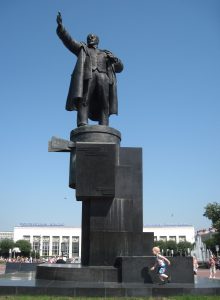 The statue marking Lenin's arrival at the 'Finland' station - M Powell-Davies
Lenin's first impressions of the welcoming ceremony arranged for him must have confirmed his worst suspicions. He was handed a large bouquet of flowers, given a ‘speech of greeting’ by Cheidze, spelling out the official Soviet ‘line’ on the revolution, and then even had to listen to a naval officer making a speech suggesting Lenin might want to become a member of the Provisional Government!
Lenin lost no opportunity to get straight to the point. He turned away from Cheidze to face the assembled crowd and spoke: “Dear comrades, soldiers, sailors and workers, I am happy to greet in you the victorious Russian revolution, to greet you as the advance guard of the international proletarian army. The Russian revolution achieved by you has opened a new epoch. Long live the worldwide socialist revolution!” [Chapter Fifteen 24 ]
The several thousand workers and soldiers who had come to welcome Lenin may not have appreciated fully the political turnaround that Lenin was determined to begin from that moment. They were simply happy to parade Lenin through the streets of Petrograd to the Bolshevik headquarters. On arriving at his party's centre, Lenin expanded his brief reply at the station into a two-hour speech addressed directly to the leading Bolshevik cadres in Petrograd. His exact words went unrecorded, but many witnesses recall the astonishment with which Lenin's ideas were met. As Trotsky says: “The fundamental impression made by Lenin's speech even among the nearest to him was one of fright. All the accepted formulas ... were exploded one after another before the eyes of that audience.” [Chapter Fifteen 24 ]
The political content of most of that speech can be read in the so-called ‘April Theses’ 27 that Lenin presented on April 4th, developing them in a speech to the Bolshevik party conference which was still going on in Petrograd. The ‘Theses’ - which can be read in full online – make a range of important proposals of which there is room only to refer to its first five points here:
1) On war: ''In view of the undoubted honesty of those broad sections of the mass believers in revolutionary defencism ... it is necessary with particular thoroughness, persistence and patience to explain ... that without overthrowing capital it is impossible to end the war by a truly democratic peace.”
2) On the revolution: “The specific feature of the present situation in Russia is that the country is passing from the first stage of the revolution – which, owing to the insufficient class-consciousness and organisation of the proletariat, placed power in the hands of the bourgeoisie - to its second stage, which must place power in the hands of the proletariat and the poorest sections of the peasantry.”
3) For “no support for the Provisional Government.” In particular, exposing the “impermissible, illusion-breeding ‘demand’ that this government, a government of capitalists, should cease to be an imperialist government”.
4) While the Bolsheviks remain in a minority to ‘patiently explain’ “that the Soviets of Workers’ Deputies are the only possible form of revolutionary government, and that therefore our task is, as long as this government yields to the influence of the bourgeoisie, to present a patient, systematic, and persistent explanation of the errors of their tactics.”
5) For a new Soviet state: “a republic of Soviets of Workers’, Agricultural Labourers’ and Peasants’ Deputies throughout the country … the standing army to be replaced by the arming of the whole people … the salaries of all officials, all of whom are elective and displaceable at any time, not to exceed the average wage of a competent worker”.
Lenin's approach shifted the whole debate from one of finding ‘objective’ excuses for supporting the bourgeoisie to subjective reasons as to why the proletariat did not seize power. As Lenin said in his speech: “The reason is that the proletariat was not sufficiently organised. The material force was in the hands of the proletariat, but the bourgeoisie was conscious and ready. That is the monstrous fact … A dictatorship of the proletariat exists, but nobody knows what to do with it.” Lenin’s speech bewildered his friends and delighted his enemies. As the Social Revolutionary Zenzinov recalls: ''His programme at that time was met not so much with indignation, as with ridicule. It seemed to everybody so absurd and fantastic. … Even his party comrades turned away in embarrassment from him.” [Chapter Fifteen 24 ]
The ‘old Bolsheviks’ thought Lenin was out of touch, and his theses found not one single open supporter beyond their author at first. Kamenev, writing in Pravda on April 8th stated: “As for the scheme of Comrade Lenin, it seems to us unacceptable in that it starts from the assumption that the bourgeois-democratic revolution is ended, and counts upon an immediate transformation of this revolution into a socialist revolution.” [Chapter Fifteen 24 ]
Lenin understood that only his policy could succeed; a policy to make the masses, and firstly his own Party, conscious of the needs of the new and unexpected post-revolutionary situation. He was not afraid to be in a minority. As he said in his speech on April 4th: “Even our Bolsheviks show confidence in the government. Only the fumes of the revolution can explain that. That is the death of socialism. If that's your position, our ways part. I prefer to remain in the minority.” [Chapter Fifteen 24 ]
24. Leon Trotsky (1930) The History of the Russian Revolution: Chapter Fifteen is available at https://www.marxists.org/archive/trotsky/1930/hrr/ch15.htm (Accessed 6 March 2026).
25. Leon Trotsky (1930) The History of the Russian Revolution: Chapter Sixteen is available at https://www.marxists.org/archive/trotsky/1930/hrr/ch16.htm (Accessed 6 March 2026).
26. Vladimir Ilyich Lenin (1917) Letters from Afar: First Letter is available at https://www.marxists.org/archive/lenin/works/1917/lfafar/first.htm#v23pp64h-297 (Accessed 6 March 2026).
27. Vladimir Ilyich Lenin (1917) 'The April Theses' is available at https://www.marxists.org/archive/lenin/works/1917/apr/04.htm (Accessed 6 March 2026).
A video summarising this fourteenth lesson: 'Video Fifteen - The Bolsheviks and Lenin' can be found here: https://youtu.be/vfzEDSFcyVM