Marxist
Education Portal

Education Portal
This lesson is the first to examine in detail an important part of the revolutionary events of 1917 – the ‘dual power’ situation that emerged from the February Revolution consisting of two conflicting regimes – the bourgeois Provisional Government and the proletarian Soviet. However, because of the role of the ‘Compromise’ parties, the real nature of that dual power was, at first, concealed.
It draws particularly from Chapter 10 of Trotsky’s ‘History’, entitled ‘The New Power’ and Chapter 11, on 'Dual Power'.
Pavel Miliukov
It’s worth remembering that the bourgeois leaders of the Progressive Bloc had spent the February days of revolution in hiding, fearing the worst. Now, to their astonishment and delight, they found that the Menshevik and Social-Revolutionary leaders had handed power over to them, behind the backs of the revolutionary masses.
The key political strategist for the bourgeois was Pavel Miliukov, the leader of the Kadet Party. Unlike some of his more liberal colleagues, many of whom had had socialistic leanings in their youth, he was unashamedly a representative of the bourgeois class.
While the petty-bourgeois 'socialists' dreamt of uniting the proletariat and bourgeoisie in some liberal alliance, Miliukov understood, just as Lenin and Trotsky did from the opposing camp, that the interests of the two classes could never be reconciled.
He knew that, despite the Soviet leadership, the revolutionary masses were never going to willingly surrender power to the bourgeoisie. However, without support from the people, Miliukov recognised that his class was in no position to break the revolution. Its only hope was to bide its time, to manoeuvre, and to gradually outwit it.
So, the bourgeoisie decided to continue with the policy that they had been using from the very start of the negotiations with the Soviet E.C. - to try and avoid any firm decisions and to postpone all reforms to some unknown future date.
Above all, the Kadets wanted to avoid, as Trotsky put it, "the fatal question of convoking a Constituent Assembly in war time” [Chapter Nine 16 ]– as they knew that, as things stood, this would result in a crushing defeat for the bourgeois parties. So, on March 6th, the Provisional Government declared it would summon the people’s representatives to a Constituent Assembly at the earliest possible date - but carefully avoided saying exactly when that date would be!
Nothing was said about the form of government. Miliukov still hoped he might be able to resurrect the monarchy as a point of support for the reaction. The only firm promise in the Declaration was to honour the secret treaties with the 'Allies' and to carry on with the war.
Trotsky sums up the situation as follows: "So far as concerned the most threatening problems of the people's existence, the revolution had apparently been achieved only in order to make the announcement: everything remains as before" [Chapter Ten of the ‘History of the Russian Revolution’ 18 ]
Although largely responsible for its political direction, Miliukov did not become leader of the Provisional Government. This grey, cowardly and unpopular man too sharply reflected the political essence of the bourgeoisie. Instead, he took the Ministry of Foreign Affairs, leaving the post of Prime Minister to the rich, but politically very ordinary, Prince Lvov.
The rich landlord Rodzianko, President of the Provisional Committee of the Duma, had been pushed to one side, his ability to mediate between the monarchy and the property-owners now unwanted, his ability to mediate between the property-owners and the revolution too transparently lacking.
The rest of the ministry was made up almost entirely by those wealthy landlords, industrialists and bourgeois politicians that the Duma had been recommending to the deposed Tsar since 1915. The Octobrist leader Guchkov became War Minister, united with Miliukov in a determination for Russia to continue the war. The portfolio of Finance went to the extremely wealthy property-owner Tereschenko, that of Agriculture to the mediocre Kadet deputy Shingarev.
Trotsky explains: “The fact is that, with one single exception, the revolution accomplished by workers and soldiers found no reflection whatever in the staff of the revolutionary government. The exception was Kerensky”. [Chapter Ten 18 ]
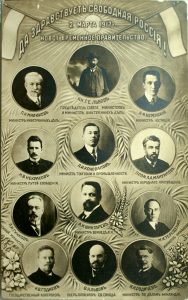 The Ministers of the Provisional Government - March 1917
Alexander Kerensky
Over the years, the capitalists have learnt that there can be at times distinct advantages in involving workers' leaders in the business of government. Abusing the trust that the masses place in them, these traitors can persuade the workers to put up with measures that they might never accept from a bourgeois politician. With this strategy in mind, the Russian liberals tried to ensnare the Menshevik President of the Soviet, Cheidze, with the offer of the Minister of Labour.
The Soviet E.C. had, however, voted against its members entering the government. But this hadn’t been for reasons of revolutionary principle! No, they knew that the Petrograd Soviet had no sympathy for the bourgeoisie, so, as Trotsky puts it, raising the question of having Soviet ministers in the government ran the risk that “The Soviet might simply answer: ‘the power ought to belong to the soviet democracy’ ". [Chapter Ten 18 ]
The Soviet E.C. decided it would be safest to avoid taking any of the responsibility for the mess that had been created. Instead, the bourgeoisie should be left to have sole charge of the revolution that the Menshevik theorists had, after all, said was only for the bourgeoisie to lead.
Kerensky, on the other hand, a lawyer and president of the small Trudovik party of Narodnik intellectuals, who had become one of the Vice-Presidents of the Soviet E.C., was not weighed down by any such theoretical considerations. He just wanted a place in the government and saw no reason why he should turn down such a golden opportunity to boost his fame!
While Kerensky's Soviet colleagues had no real objection to him taking a portfolio, they couldn't risk giving him an official sanction in full view of the revolutionary masses. But Kerensky wanted to enter the government with the aura of a revolutionary leader.
Without warning the Soviet leaders, he announced to a full session of the Soviet that he was ready to die for the revolution, but more immediately he was more than ready to take the position of Minister of Justice! Convinced by Kerensky's promises of a complete political amnesty and a prosecution of the Tsar's officials, the inexperienced assembly gave him a mighty round of applause. Kerensky took this as a vote of confidence and promptly accepted the post in the government.
The Soviet E.C., under the leadership of Sukhanov and the Mensheviks Cheidze and Skobelev, were fairly content with the situation. They had successfully avoided taking the power that they so dreaded and were able to announce support for the Provisional Government ‘in so far as’ it truly served the democratic revolution. Or, as Trotsky put it more pointedly, “this support was promised only as a reward for good behaviour - that is, for fulfilling tasks alien to it, and which the democracy itself had declined to fulfil” [Chapter Ten 18 ] !
The E.C. set up a ‘Contact Commission’ as a 'go-between' to negotiate between the Soviet and the Government. This ludicrous body became, of course, only a talking shop in which two irreconcilable classes would try, and fail, to reach a mutually agreed compromise.
As for Kerensky's portfolio, once the question had passed without too much trouble through the Soviet, the E.C. leaders were happy enough. After all, now the intelligentsia had their own man in the government to let them know what the capitalists were up to.
Real power lies with the Soviet
The revolutionary masses viewed the situation with very different emotions. “Among the workers and soldiers the composition of the government created an immediate feeling of hostility, or at the best a dumb bewilderment. The name of Miliukov or Guchkov did not evoke one voice of greeting in either factory or barrack. Officer Mstislavisky reports the sullen alarm of his soldiers at the news that the power had passed from tsar to prince: Is that worth shedding blood for?” [Chapter Ten 18 ]
The only name greeted with any enthusiasm was that of Kerensky. He was now being made out by the bourgeoisie to be the central hero of the revolution! Trotsky explains how the inexperienced masses saw Kerensky’s participation in government as the first step towards the removal of the bourgeoisie and the landowners. They only wondered why he was there alone. What they did not yet recognise was that Kerensky was not "a counterpoise to the bourgeois government ... but a finishing touch, a screen, a decoration. He was defending the same interests as Miliukov, but with magnesium flashlights.” [Chapter Ten 18 ]
The masses not only did not trust or support the bourgeoisie; they did not even distinguish them from the nobility and the bureaucracy. They put their weapons only at the disposal of the soviets. These had sprung up out of the blue, thanks to the tradition of 1905, giving them tremendous power.
In bourgeois circles, and in the Allied embassies, the new government had been greeted with satisfaction and relief. Nevertheless, the capitalists did not feel that they were really in charge. Under the Tsar, despite the intrigues of the Rasputin clique, the bourgeoisie felt that they had real influence. If nothing else, the factories, land, banks, houses, newspapers and so on had been guaranteed to the property owners. Now, the revolution threatened to call all this into question.
The reality was, indeed, that, while the bourgeois government had the external attributes of power, real power was in the hands of the soviets. All of the upper layers of society - officers, directors, landlords, factory managers - felt that they were under the constant suspicious scrutiny of the masses. The Soviet had become an organised expression of the masses' distrust. Trotsky relates how “typesetters would jealously follow the text of the articles which they had set up ... soldiers would glance around suspiciously every time their officer made a move, workers would dismiss from the factory an overseer belonging to the [ultra-reactionary monarchist] Black Hundreds and take in under observation a liberal manager. The Duma from the first hours of the revolution, and the Provisional Government from its first days, became reservoirs into which flowed a continuous stream of complaints and objections from the upper layers of society, their protests against 'excesses', their woeful comments and dark forebodings.” [Chapter Ten 18 ]
Dual Power in the English Revolution
In Chapter Eleven of his ‘History’, Trotsky inserts a “theoretical inquiry (that seems to have) led us away from the events of 1917 (but) in reality leads right into the heart of them”. [Chapter Eleven of the ‘History of the Russian Revolution’ 19 ]
Trotsky explains that the ‘dual power’ situation that existed in Russia in 1917 was certainly not unique in history. On the contrary, it is a fundamental element of a revolutionary period. Indeed, a genuine dual power can only exist at such a time, when irreconcilable classes are fighting each other for control of society.
Trotsky explains that, in normal times, society needs a single government in order to advance, but that only happens when a strong ruling class is able to stamp its economic and political regime on the whole of society. In a time of revolution, when the old ideas are being challenged, the new revolutionary class strives to lay claim to state power.
It will either create its own alternative state organisation, or take over and adapt existing institutions. However, such a transformation does not develop from nowhere overnight. There is inevitably a more drawn-out period of instability where the two conflicting half-ruling classes are struggling to impose full control over the other. The actual amount of power falling to either side at any particular time depends on the balance of forces in the struggle. This ‘double sovereignty’ may be endured for some time, but will inevitably lead to open conflict, even to civil war.
To give just one example – although Trotsky comments on the French Revolution too - the English Revolution of the seventeenth century became exactly such a civil war. A new bourgeois class had gradually obtained more and more economic power until it came to a point where it had to do battle with the old privileged classes of the monarchy, aristocrats and bishops in order to make any further advance. The ‘dual power’ turned into open civil war between the royal power based in Oxford, and the new power based around Parliament and the City of London.
The Parliamentarians emerged victorious – but only after they had also been confronted with a new challenger - the 'Independents', based on the parliamentary army, representing the petty bourgeoisie, the craftsmen and farmers. A new dual power emerged, with the new class again relying on a new state organisation, in this case the council of soldiers' and officers' deputies of the Independents' ‘New Model Army'.
This double sovereignty was ended by the victory of this army, leading to the dictatorship of Cromwell. A third dual power was threatened by the struggle of the lower ranks of the army, under the leadership of the Levellers, but this extreme left-wing of the revolution was soon defeated.
Just like their English counterparts, the Russian bourgeoisie entered the revolution having already concentrated a good share of the state power in its hands. Thanks to its position in the Military-Industrial Committees and local government bodies, the bourgeoisie had gained more and more economic and political control, setting up an initial dual power that quickly led to the defeat of Tsarism in February. However, and far more rapidly than in the English Civil War, a new political force arose to challenge the capitalists’ power.
Another dual power was set up between conflicting state organisations, the Provisional Government acting for the bourgeoisie, and the Soviet, acting in the interests of the workers and peasants. As Lenin pointed out when also emphasising the existence of this ‘dual power’ soon after his return to Russia in April, this was a new type of power – akin to that set up by the Communards of Paris in 1871 - because it was “based on the direct initiative of the people from below, and not on a law enacted by a centralised state power". [Lenin, The Dual Power 20 (1917)]
In previous revolutions the dual power had arisen as a natural stage in the struggle with the contending forces trying to replace the double sovereignty with their own rule. Trotsky explains that the peculiarity of the February Revolution was that "we see the official democracy consciously and intentionally creating a two-power system, dodging with all its might the transfer of power into its own hands. The double sovereignty is created, or so it seems at a glance, not as a result of a struggle of classes for power, but as the result of a voluntary yielding of power by one class to another. … If you look deeper, the twofold rule of the Provisional Government and the Executive Committee had the character of a mere reflection ... (it) only reflected the still concealed double sovereignty of the bourgeoisie and the proletariat. When the Bolsheviks displace the Compromisers at the head of the Soviet ... then that concealed double sovereignty will come to the surface, and this will be the eve of the October Revolution". [Chapter Eleven 19 ]
16. Leon Trotsky (1930) The History of the Russian Revolution: Chapter Nine is available at https://www.marxists.org/archive/trotsky/1930/hrr/ch09.htm (Accessed 6 March 2026).
18. Leon Trotsky (1930) The History of the Russian Revolution: Chapter Ten is available at https://www.marxists.org/archive/trotsky/1930/hrr/ch10.htm (Accessed 6 March 2026).
19. Leon Trotsky (1930) The History of the Russian Revolution: Chapter Eleven is available at https://www.marxists.org/archive/trotsky/1930/hrr/ch11.htm (Accessed 6 March 2026).
20. Vladimir Ilyich Lenin (1917) The Dual Power is available at https://www.marxists.org/archive/lenin/works/1917/apr/09.htm (Accessed 6 March 2026).
A video summarising this ninth lesson: 'Video Nine - The Paradox of the February Revolution' can be found here: https://youtu.be/MdegupNgzI8
An additional short video summarising the more generalised points made by Trotsky about 'dual power': 'Video Eleven - The Dual Power' can be found here: https://youtu.be/zrNb-70VS0Q